
For more than a decade, we have been exploring a central question: How do brands actually create impact?Not from a campaign perspective, but from the perspective of effect, meaning, and identity.
Our conviction is clear: Brands are not linear instruments of impact. They do not work like funnels, journeys, or sequences of touchpoints.
Marken wirken, wenn sie angeeignet werden - durch das Relationale Markenmodell.
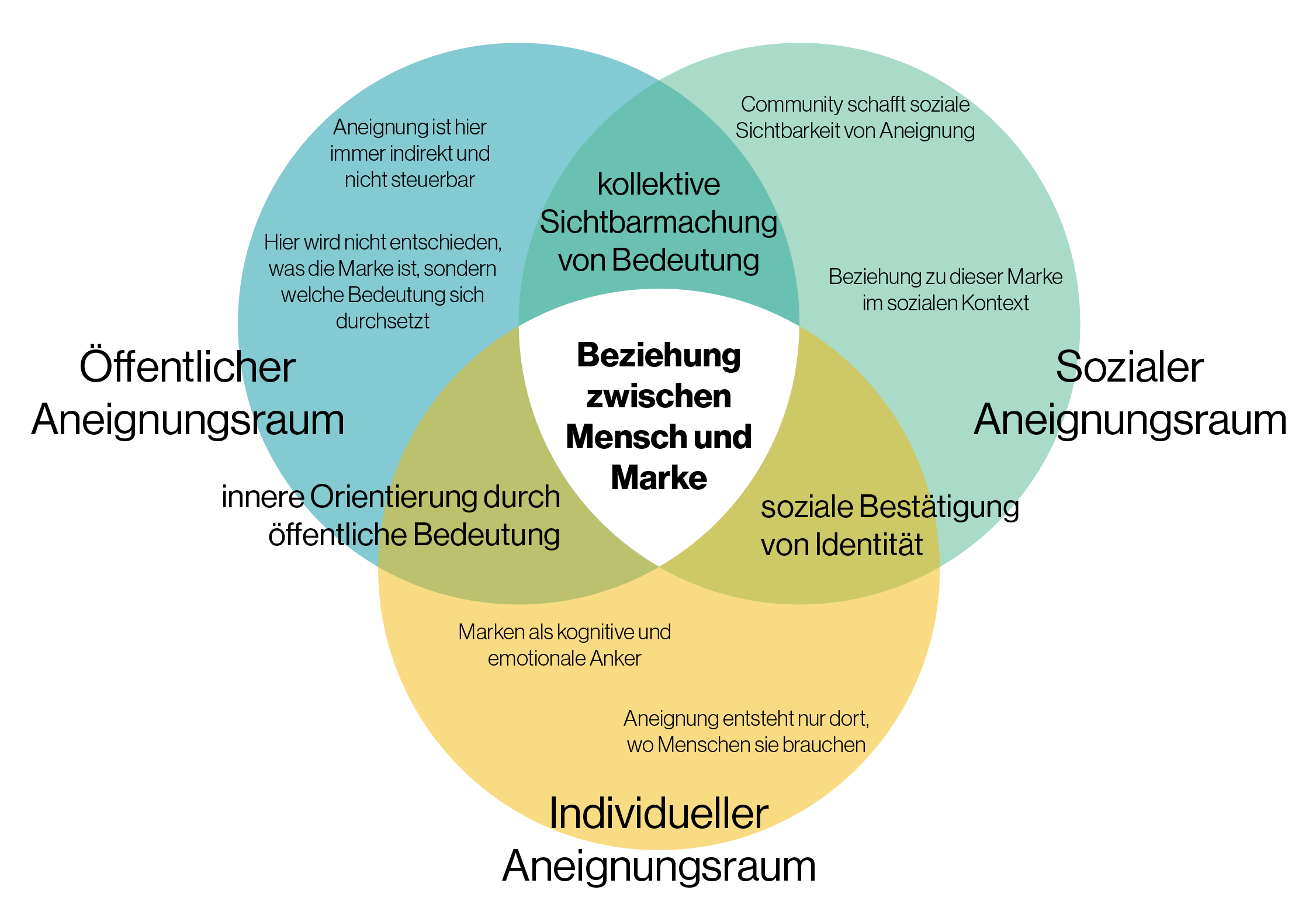
The Relational Model of Brand Appropriation and Orientation is based on the assumption that brands should not primarily be understood as linear mechanisms of effect or as controllable objects of communication, but rather as relational structures of meaning and orientationthat are constituted only in the enactment of interaction between the individual, the social context, and the public sphere. Accordingly, brands do not exert their influence through sequential processes (e.g., funnels or journeys), but through situated processes of appropriationin which individuals integrate brand meanings into their self-conception, social positioning, and orientation for action. Appropriation in this sense is neither ownership nor attachment, but a temporary, reversible, and context-dependent form of meaning integration..
People use brands to gain orientation, stabilize identity, and reduce complexity. Similar to spaces or territories, brands are not merely perceived or consumed — they are emotionally integrated, socially mirrored, and situationally activated..
From this perspective, we understand brands not as static senders, but as dynamic spaces of appropriation..
Our framework distinguishes three interconnected levels through which brands create impact:
Individual - This is where it is decided whether a brand fits one’s self-image. Appropriation means: This brand may become part of my identity.
Social - Brands are confirmed, challenged, or reinterpreted through interaction with others. Here, brands lose control — and gain meaning.
Public - Brands operate within open cultural and media contexts. Visibility alone is not enough — only meaning that is connectable and relevant becomes effective.
Successful brands enable coherent appropriation across all three levels..
This framework was not developed retrospectively, but through continuous engagement since 2012.
Today, more than ever:
A brand is not a stable space, but a processual system of orientation
Appropriation is situational, context-dependent, and reversible
Public space is no longer a place, but a mechanism of selection — media-driven, cultural, algorithmic
Interactions with platforms, services, and AI are part of brand reality
Brands are no longer “owned.” They are activated..
Our understanding of systemic brand strategy. is rooted here.
Brand, storytelling, platforms, and activation are not isolated disciplines — they are parts of a coherent system of impact..
We do not work on measures. We design the conditions that allow brands to be appropriated, used, and become effective..
Brands do not create impact through volume. They create impact through connectivity.