
Fan Relationship Management in Sport: The System Behind Owned Fans
On this page
Fan relationship management in sport is often mistaken for CRM, marketing automation or better content distribution. That is the problem. The real task is not to manage contacts. It is to build a system that turns reach into direct, owned and measurable fan relationships.
What fan relationship management means in sport.
Fan relationship management is the discipline of building, developing and monetising direct fan relationships across identity, data, platform, content, commercial value and operating model. It is not one tool. It is the strategic architecture behind the tools.
This distinction matters because most sport organisations already have digital activity. They have social reach, matchday content, newsletters, ticketing data, apps, shops and sponsor activations. What they often do not have is one connected system that makes those assets compound.
A fan can watch every highlight, like every post and attend every home game while still remaining invisible to the organisation as an owned relationship. The audience exists. The relationship does not.
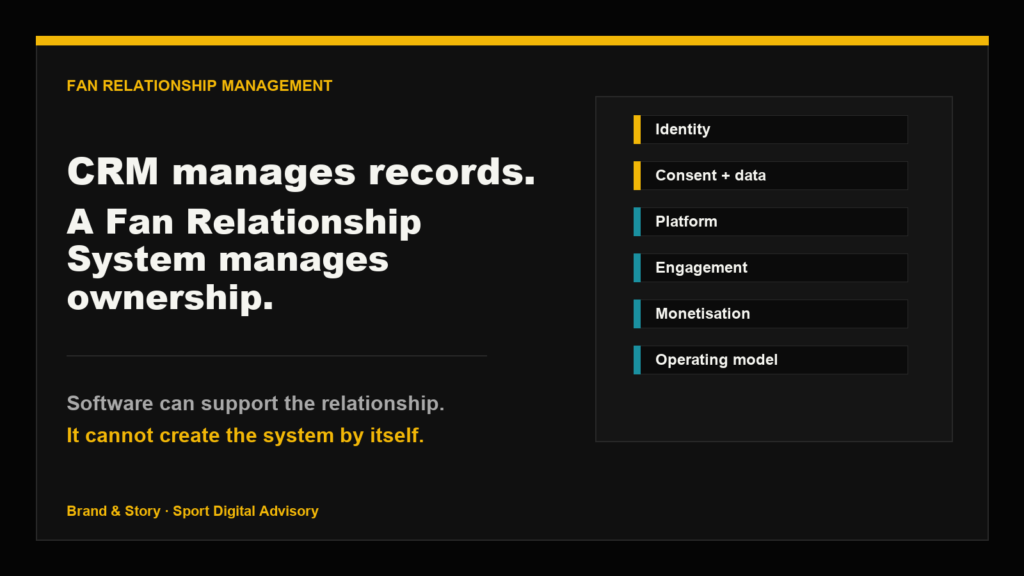
CRM manages known contacts.
CRM is useful once the organisation knows who the fan is. It can store profiles, track communication and support sales or service workflows. But it does not create the full relationship system by itself.
A Fan Relationship System creates the architecture.
The system defines how identity, first-party data, platform logic, engagement, monetisation, sponsorship and operations work together. CRM and CDP can be components. They are not the strategy.
Why the CRM-first approach fails.
The common procurement logic is simple: we need better fan relationships, therefore we need a CRM. But in sport that sequence is often backwards.
If the identity layer is weak, the CRM has too few meaningful profiles. If the data model is fragmented, the CRM stores partial records. If the content system is built only for reach, the CRM receives little relationship intent. If commercial teams measure sponsorship only through exposure, the CRM cannot prove audience value.
The tool can only manage the relationship that the system has already made possible.
That is why fan relationship management starts before software selection. It starts with the system question: which layer currently prevents the organisation from turning audience attention into owned fan value?
The seven layers behind fan relationship management.
01 Identity
Registration, login, SSO and fan profiles. Without identity, the organisation has audience signals but no direct relationship.
02 First-party data
Consent-based behavioural, preference and transaction data. This is the asset that makes fan relationships measurable.
03 Platform
Website, app, ticketing, commerce and data infrastructure connected by one experience and identity logic.
04 Content and engagement
Content that does more than reach: it moves fans toward identity, preference, participation and value exchange.
05 Monetisation
Membership, D2C, premium access, products and fan lifetime value. Commercial models built on direct relationships.
06 Sponsorship activation
Audience insight and measurable activation, not only logo exposure or estimated reach.
07 Operating model
Ownership, governance, roles, vendor management and KPIs. The system has to run inside the organisation.
What sport organisations should diagnose first.
Before selecting a CRM, rebuilding an app or launching another engagement campaign, leadership should ask four questions.
1. Do we know who our fans are across touchpoints?
2. Can we connect content behaviour, ticketing, commerce and preference data?
3. Does our content system create identity and data, or only reach?
4. Can we translate fan relationships into commercial value for D2C, membership and sponsorship?
If the answer is unclear, the problem is not a missing feature. It is a missing architecture.
How this connects to the Fan Relationship System.
Brand & Story uses the Fan Relationship System as the infrastructure model for fan relationship management in sport. It shows which layer is missing, which layer is overloaded, and which layer should be fixed before the next technology or content decision.
For a deeper technology distinction, read Fan Relationship System vs CRM vs CDP. For a strategic diagnostic, start with the Fan Relationship System Assessment.
Frequently asked questions.
Is fan relationship management the same as CRM?
No. CRM manages known contacts and workflows. Fan relationship management is broader: it defines how a sport organisation creates, develops and monetises direct fan relationships across identity, data, platform, content, commercial value and operations.
Why is fan relationship management important in sport?
Sport has high emotional reach but often weak direct audience ownership. Fan relationship management turns that reach into registered, permission-based and measurable relationships that can support content, D2C, membership and sponsorship.
What should a sport organisation fix first?
Usually the first question is identity: can the organisation recognise the same fan across website, app, ticketing, commerce and communication? If identity is weak, later layers such as first-party data, personalisation and monetisation cannot compound.