
Fan Relationship Management for Sport Organisations.
Fan relationship management in sport is not another engagement tactic. It is the infrastructure that connects identity, consent, first-party data, owned channels, monetisation, sponsorship value and operating model, so sport organisations can turn reach into direct, measurable fan relationships.
When a sport organisation needs a Fan Relationship System
Choose a situation to explore related layers. This is a starting point, not a diagnosis.
- social reach is high, but direct fan data is weak
- ticketing, CRM, app, content and sponsorship data sit in separate systems
- fan engagement is measured, but fan lifetime value is not
- sponsors receive exposure reports, but not relationship proof
- digital work creates activity, but not owned audience value
The system in practice
Each of the 7 layers — what it does and why it matters
The Fan Relationship System is the strategic model behind it. It shows which layer is missing, which layer is weak, and why content, data, sponsorship or platform investments fail when they are not connected by one digital ecosystem logic.
Select a layer to explore its role.
The system in practice
How Brand & Story works.Identity Layer
Registration, login, fan profiles, SSO. The first step from borrowed to owned audience. Without this layer, there is no system.The system in practice
Layer 01
Identity Layer
The Identity Layer is the mechanism by which a sports organisation knows who its fans are — not as aggregate analytics, but as identifiable individuals. It is the first layer of the Fan Relationship System because nothing else in the architecture functions without it. You cannot personalise content for an anonymous user. You cannot build a first-party data asset without a subject to attach it to. You cannot measure fan lifetime value without knowing which fans you’re measuring.
Without an Identity Layer, you have audiences — not relationships. Every digital touchpoint you operate produces data, but without a connected identity infrastructure, that data is anonymous noise: page views without names, video plays without profiles, ticket scans without purchase histories. Social platforms hold that identity data, and they don’t share it with you. Two million Instagram followers means two million people you cannot contact, cannot segment, and cannot convert directly.
The concrete components of an Identity Layer are: registration flows (web and app, with clear value exchange — why should a fan register?), login systems (persistent, frictionless, cross-device), fan profiles (structured data storage at the individual level), and Single Sign-On (SSO) across every platform the organisation operates — website, app, ticketing system, e-commerce, community. Without SSO, identity fragments: the same fan is a different user in every system, and no unified picture is ever possible.
Progressive profiling is the operating mechanism: fans give you a little data at first (email, name, favourite team), and the system gathers more over time through behaviour, preferences, and explicit interactions. This is the ethical and effective way to build a fan data asset — not a one-time data dump, but a relationship that grows.
What the Identity Layer enables: personalisation at scale, attributed data collection (every behaviour linked to a real person), the foundation for first-party data strategy, and — commercially — the ability to tell sponsors exactly who your fans are.
First-Party Data
Structured fan data: behavior, preferences, transactions. GDPR-compliant, usable for personalization, segmentation and sponsoring insights.The system in practice
Layer 02
First-Party Data
First-party data is the structured record of fan behaviour, preferences, and transactions — collected directly by the organisation, with fan consent, through its own digital infrastructure. It is not bought, rented, or estimated. It is observed, consented, and owned. This is the most durable and strategically valuable data asset a sports organisation can build.
The distinction from third-party data matters more now than it ever has. Third-party data was always aggregated, probabilistic, and rented — you paid for access to audience pools you didn’t own, built by platforms that tracked users across the web. That model is functionally over: cookies are gone, Apple’s ATT framework has gutted mobile tracking, and privacy regulation is tightening in every major market. Organisations that didn’t build a first-party data strategy five years ago are rebuilding from scratch now. Those that start today have a clear runway.
In a sports context, first-party data covers several distinct categories: behavioural data (which content a fan consumes, at what frequency, on which device, in what competition phase), preference data (explicit — „favourite athlete“, „preferred notification type“ — and inferred from behaviour), transactional data (ticketing history, merchandise purchases, subscription status), and attendance data (where fans are, how often, in what configuration). Each data type tells a different part of the fan story.
GDPR compliance is not a constraint — it’s a framework. Consent-based data collection, when done properly, builds fan trust. Fans who understand what data you collect and why are more likely to engage, not less. The operational requirements — consent management, data storage standards, right-to-erasure processes — are manageable and necessary.
What first-party data enables: personalisation (right content to the right fan at the right time), segmentation (audiences defined by behaviour, not demographics alone), predictive modelling (CLV, churn risk, upgrade propensity), and — critically — sponsoring insights. The ability to show a sponsor exactly who your registered fans are, what they buy, and what they care about is a commercial differentiator that no amount of social reach can replicate.
Platform
Web, app, digital ecosystem. Architecture that scales. Vendor selection, tech stack, integration of existing tools. Platform is not an end in itself — it enables all other layers.The system in practice
Layer 03
Platform
The Platform layer is the technical infrastructure that connects every touchpoint in the fan relationship architecture. Website, app, ticketing system, e-commerce, content management, data storage — these are not separate products. In a functioning Fan Relationship System, they are components of a unified platform model, sharing identity data, feeding a common analytics layer, and operating under a consistent experience logic.
Web and app are the primary owned surfaces. Both must operate from the same identity layer — a fan who logs in on the website is the same fan on the app, with the same profile, the same data, the same purchase history. This sounds obvious and it rarely exists. Most sports organisations have separate identity systems for their website CMS, their app platform, their ticketing vendor, and their e-commerce provider. The result: four different user records for the same fan, four datasets that never talk to each other, and a data asset that is worth a fraction of what it should be.
Architectural decisions at this layer have ten-year consequences. API-first, headless architectures give you flexibility — the ability to swap front-end experiences without rebuilding the data infrastructure underneath. Composable commerce enables you to plug in the best ticketing solution, the best e-commerce engine, and the best content management system, rather than being locked into one vendor’s interpretation of all three. Tech stack decisions should be made on the basis of integration capability and data model compatibility, not on which platform has the best sales team.
Vendor selection at the Platform layer is a strategic decision, not a procurement exercise. The question is not „which CMS is best?“ The question is: which combination of vendors can be integrated into a unified data model, maintained by our team, and evolved as our fan relationship strategy evolves?
The Platform layer is an enabler, not an endpoint. The most common mistake is treating the launch of a new platform as the achievement. It isn’t. The platform is the infrastructure on which the system above it — identity, data, content, monetisation, sponsorship — runs. A well-built platform is invisible. It just works. What’s visible is everything it makes possible.
Content & Engagement
Storytelling with system logic. Content that deepens relationships instead of just generating reach. The Relational Brand Model as foundation.The system in practice
Layer 04
Content & Engagement
Content is the most visible layer of the Fan Relationship System and the most commonly misunderstood. The widespread assumption is that content is about reach — produce compelling material, distribute it as widely as possible, and results follow. This produces good social metrics and weak business outcomes. Content with system logic operates differently: every piece has a purpose beyond impressions.
System-logic content asks three questions before it is published: Does this piece deepen fan identity (does it give someone a reason to register or log in)? Does it generate useful data (does it tell us something about this fan’s interests, preferences, or state)? Does it move the fan toward a value exchange (does it position a membership offer, a product, access to something exclusive)? Content that answers none of these questions may still have a place in the mix — but it is not strategic content. It is ambient noise.
The Relational Brand Model frames content as a progression, not a feed. Fans exist on a spectrum from unaware to deeply committed. Content should be designed to move fans along that spectrum: awareness content that introduces, engagement content that deepens, commitment content that converts. This is not a funnel — fans move non-linearly. But understanding where a fan is on the relationship curve changes what you offer them.
Touchpoint mapping across the sporting year is essential because fan attention is not constant. A football fan’s engagement in August (pre-season, optimism, anticipation) is categorically different from their engagement in February (mid-season, potential relegation battle, fatigue). A cycling fan’s relationship with a team during the Tour de France is qualitatively different from November. Content systems that don’t account for the emotional and attentional shape of the sporting year produce flat engagement curves.
Mapping touchpoints means identifying every moment in the calendar where fan attention is naturally high — and building content and activation strategies that meet fans where they are. It also means designing evergreen content infrastructure for the off-season: behind-the-scenes access, athlete storytelling, training content — the material that keeps a fan relationship alive when there are no results to report.
Monetization
Membership, D2C, premium content, digital products. Value creation directly from the fan relationship — without intermediaries. Goal: measurably increase Customer Lifetime Value.The system in practice
Layer 05
Monetization
Monetisation in a Fan Relationship System does not mean extracting value from fans. It means creating value pathways through which fans choose to pay — because what they receive is worth more to them than what they give. This distinction changes everything about how you design the commercial layer.
Direct-to-consumer (D2C) is the structural goal: removing ticketing platforms, retail distributors, broadcast intermediaries, and social media as gatekeepers between the organisation and its fans‘ wallets. Every intermediary takes margin and owns the transaction data. A fan who buys a jersey through your own store generates revenue and first-party data. The same fan buying through a retail partner generates only revenue — and even that is margin-diluted.
Membership models are the compounding mechanism. A well-designed membership programme converts casual fans into committed ones through tiered access: free membership (registration-level, data collection, light personalisation), premium membership (exclusive content, early access, discounts, community features), and VIP or supporter tiers (deep access, physical experiences, priority ticketing). Each tier represents a different relationship depth — and a different revenue profile.
Digital products extend the monetisation surface beyond physical goods and tickets: premium content packages (seasonal, event-specific), exclusive video archives, digital collectibles, fantasy and prediction games with paid entry, live audio commentary, athlete Q&A access. These products have near-zero marginal cost compared to physical inventory and can be personalised — the right product offered to the right fan at the right moment in the sporting calendar.
CLV (Customer Lifetime Value) optimisation is the long-game framework. A fan who registers, engages with content, buys merchandise, and attends events generates dramatically more lifetime value than one who only follows on social. Understanding CLV by fan segment enables rational investment decisions: how much is it worth to acquire a new registered fan? What is the financial case for reducing churn by 10%? What does a membership conversion rate increase of 5 percentage points mean in three-year revenue terms? These are the questions that monetisation strategy at this layer answers.
Sponsorship Activation
Data-driven sponsoring offers instead of reach promises. Audience insights for partners. Measurable activation instead of logo placement.The system in practice
Layer 06
Sponsorship Activation
Sponsorship in sport is undergoing a structural shift. The traditional model — logo placement, brand association, estimated reach — is being replaced by a data-driven model in which sponsors expect to understand exactly who they are reaching and what those people do. The organisations that can deliver this are winning better contracts, at better rates, with better renewal rates. The organisations still selling banner impressions and jersey logos without audience data are losing ground.
First-party data is the sponsoring currency of the next decade. When you can walk into a sponsorship conversation and say: „We have 340,000 registered fans. Here’s their age distribution, their household income quartiles, their geographic spread, their content preferences, their purchase behaviour, and their event attendance patterns“ — you are not selling reach. You are selling a verified audience. That conversation is categorically different from „we have 2 million social followers.“
Measurable activation replaces logo placement as the standard. This means designing sponsor integrations that produce measurable fan behaviour: a sponsor-branded exclusive content series that drives registered fan growth; a partner-led membership benefit that increases upgrade rates; a co-branded digital product with trackable conversion. Each activation can be tied to a metric. Each metric can be reported. Each report builds the case for renewal.
The compliance consideration: audience insights for sponsorship must be aggregated, not individual. GDPR-compliant sponsor reporting means providing segment-level data — „fans who purchased in the last 90 days index 2.3x over the general population for premium car ownership“ — not individual-level profiles. Done correctly, this is both legally sound and commercially compelling.
Why this matters now: advertising cookies are disappearing. Apple’s App Tracking Transparency framework has made mobile audience targeting increasingly opaque. Social platforms restrict brands‘ ability to reach sports fans directly. Sponsors are under CFO pressure to demonstrate ROI. The sports organisation with a first-party data infrastructure and an audience-insight-led sponsorship proposition is solving a real problem for its commercial partners — and that is a durable competitive advantage.
Operating Model
Governance, team setup, vendor management, KPI frameworks. The system must run internally — not as a consultant product. The operating model secures ownership long-term.The system in practice
Layer 07
Operating Model
The Operating Model is the layer that determines whether the Fan Relationship System compounds over time or gradually degrades. Technology, strategy, and content are necessary. They are not sufficient. Without clear internal governance, defined ownership, and a KPI framework that connects digital activity to commercial outcomes, even well-designed systems drift. Teams make local decisions that undermine the architecture. Vendors accumulate technical debt. Metrics drift toward vanity. The system stops compounding.
Governance means answering: who owns the fan relationship system? Not the platform — the system. Who is responsible for the growth of the registered fan base? Who owns the first-party data strategy? Who arbitrates when the commercial team and the digital team disagree about a sponsor activation that conflicts with the content model? Without explicit answers to these questions, the default is: nobody owns it, and everybody optimises locally.
Team setup for a Fan Relationship System requires cross-functional collaboration that most sports organisations haven’t historically needed: digital and data working from the same strategic brief, content and commercial aligned on what the fan relationship is worth, technology and operations understanding what the platform is supposed to enable six months from now. The silo structure — digital does digital, commercial does commercial, data belongs to nobody — is the single most common reason fan relationship systems fail to scale.
Vendor management at this layer means owning the vendor relationships, not being owned by them. The platform layer involves multiple external partners — CMS, app, ticketing, CRM or CDP, analytics. Each has different contract structures, SLAs, and integration requirements. The operating model defines who manages these relationships, what the escalation path is when integration breaks, and what the exit strategy is if a vendor becomes unsuitable.
KPI frameworks connect digital activity to business outcomes. Monthly active users matter — but only in relation to registered fan growth. Engagement rate matters — but only in relation to content that drives identity or monetisation events. The KPI framework for a Fan Relationship System measures: registered fan base size and growth rate, first-party data volume and quality, fan CLV by segment, D2C revenue share, membership conversion and retention, and sponsorship data-value delivered. These are the metrics that tell you whether the system is working. And the most important property of a well-run system: the compound effect. More data enables better personalisation. Better personalisation drives more engagement. More engagement grows the registered fan base. A larger registered fan base increases the data asset. A richer data asset unlocks better sponsorship value. This loop — not any single campaign — is what a Fan Relationship System delivers.
Why a system, not a strategy?
Strategy papers explain what should be done. A system explains how it works — and then runs without external dependency. Brand & Story builds systems, not presentations.
Owned
The fan data, the relationships, the infrastructure — belong to the rights holder. No platform dependency, no algorithm risk.Scalable
New layers, new markets, new monetization channels — without rebuilding. The system grows with the organisation.Measurable
Registrations, engagement depth, CLV, sponsoring revenue — every layer has clear KPIs. All controllable.Story + Platform + Value Creation.
Three dimensions. One system. None sufficient alone. Together they create Owned Fan Relationships that are measurable and scalable.
Narrative foundation, Relational Brand Model, content with system logic. Without story no appropriation. Without appropriation no relationship.
Identity Layer, First-Party Data, digital ecosystem. The technical basis for Owned Fan Relationships.
Monetization, Sponsorship Activation, D2C, Membership. Translate relationships into measurable business value — directly, without intermediaries.
How Brand & Story works.
Diagnosis → Architecture → Prioritization → Implementation. No full-service retainer. Clear mandates, measurable results.
Audit & Diagnosis
Which layers are missing, which are weak, which already work? Honest analysis without sales logic.Strategy & Architecture
The Fan Relationship System for your organization: which layers in which order, with which budget, with which partners.Implementation & Steering
Vendor management, team setup, KPI tracking. Until the system runs internally and independently.30 min · Free · No pitch
Assessment fit
Use the Fan Relationship System when activity exists, but ownership does not.
The assessment is useful when a sport organisation already has digital activity, but still cannot prove which fan relationships it owns, activates and monetises directly.
Good fit if…
- reach is visible, but the relationship is not owned
- fan data exists, but it does not drive revenue decisions
- sponsorship proof is still mostly exposure-based
- CRM, app, ticketing and content work as separate systems
What happens in the assessment
- map the current fan relationship architecture
- identify the layer that blocks direct value creation
- define the next architecture move before vendor decisions
- turn the result into a focused advisory or implementation mandate
Assessment
Not sure which layer blocks direct fan value?
Start with the diagnostic before turning this into an advisory or implementation mandate.
Frequently asked questions about fan relationship management.
What is fan relationship management in sport?
Fan relationship management in sport is the advisory and operating discipline of turning reach, attendance and engagement into direct, permission-based and measurable fan relationships. It connects identity, consent, first-party data, owned channels, monetisation, sponsorship value and operating model.
What is a Fan Relationship System?
A Fan Relationship System is the strategic infrastructure model that connects identity, consent, data, platform, engagement, monetisation, sponsorship and operating model so a sport organisation can build owned, measurable fan relationships.
When does a sport organisation need a Fan Relationship System?
A sport organisation needs a Fan Relationship System when reach is high but direct fan relationships, first-party fan data, monetisation paths or sponsorship proof remain weak. The system shows which layer blocks measurable audience value.
How is fan relationship management different from CRM or CDP?
CRM and CDP tools can support fan relationship management, but they do not define the system. Fan relationship management decides how identity, data, owned channels, value creation and operating model work together before tool decisions are made.
What are the best tools for managing fan relationships?
The best tools for managing fan relationships depend on the layer that blocks value. CRM, CDP, membership, ticketing, app and marketing automation tools can all help, but the strategic decision comes first: identity, consent, first-party data, owned channels, monetisation, sponsorship proof and operating model must work together.
Further reading
Fan relationship management is infrastructure, not a tool decision
Definition
Fan relationship management is infrastructure, not a tool decision
Fan relationship management means designing the connected system that turns anonymous reach into known, permission-based and commercially useful fan relationships. A CRM or CDP can support that system, but the strategic question is how identity, data, engagement and value creation work together.
For Brand & Story, fan relationship management connects sport digital strategy, identity, first-party fan data, owned channels, monetisation, sponsorship value and operating model into one digital ecosystem architecture.
The Fan Relationship System behind fan relationship management
The Fan Relationship System behind fan relationship management
A Fan Relationship System defines how identity, consent, data, platform, engagement, monetisation, sponsorship and operating model work together to create direct fan relationships.
CRM and CDP tools can support parts of the system, but they do not define the operating logic. The strategic question is not which tool stores fan data, but how the organisation creates, owns and activates the relationship.
What a sports digital ecosystem actually requires
Sports digital ecosystem
What a sports digital ecosystem actually requires
A sports digital ecosystem is not a website and an app. The confusion is common, the consequences are expensive, and the correction is rarely quick.
An ecosystem is the entire connected infrastructure through which a sports organisation owns, develops, and monetises fan relationships at scale. Website and app are part of it. They are not the sum of it. Social channels are distribution surfaces at the edge of it — important, but not owned, and not the centre of gravity.
The confusion matters because organisations make investment decisions based on the wrong model. They build an app, get 50,000 downloads, see engagement numbers plateau at month six, and conclude that digital doesn’t move the needle. It didn’t move the needle because the app was built without identity architecture, without a first-party data strategy, and without a content model that gives fans a compound reason to return. The infrastructure was platform without system.
The three most common failure patterns
Failure 01
Engagement without identity
Producing content without a registration layer means building someone else’s audience. Every video view on Instagram, every post share, every match highlight on YouTube — none of that data belongs to you. You’ve generated reach, not relationship. When the platform changes its algorithm, you lose access. You never had access to begin with.
Failure 02
Platform without strategy
Technology without a purpose is expensive infrastructure. Many organisations invest in a platform rebuild — new website, new app, ticketing integration — without defining what fans should do there, what data should be collected, or how the experience should evolve. The result is a product that doesn’t compound. Beautiful UX, no systemic outcome.
Failure 03
Data without use
The organisation that collects data but doesn’t act on it is accumulating technical debt, not assets. Data has no value in a database. It has value when it drives personalisation decisions, powers segmentation, informs content strategy, and backs commercial conversations with sponsors. Unused data is a GDPR liability, not a business asset.
What a complete ecosystem looks like
A functioning sports digital ecosystem connects seven elements into a single operational logic: an identity layer that captures fan identity across every touchpoint; a first-party data infrastructure that converts fan behaviour into structured, usable data; a platform architecture where web, app, ticketing, commerce, and content share a single data model; a content system with purpose beyond impressions; monetisation pathways that convert fan relationships into direct revenue; sponsorship propositions built on audience data; and an operating model with clear ownership and governance.
None of this is fundamentally about technology. It’s about decisions: which vendors, which integrations, which fan behaviours matter commercially, how digital and commercial teams collaborate, how the system is designed to improve over time. The technology executes the strategy. The strategy has to come first.
Why engagement alone doesn’t build a fan relationship
Fan engagement strategy
Why engagement alone doesn’t build a fan relationship
Reach and relationship are not the same thing. Most sports organisations optimise for reach and wonder why the business outcomes don’t follow.
A like is not a relationship. A view is not loyalty. A follower count is not an asset — it’s a number that lives on someone else’s platform, subject to algorithm changes, policy decisions, and platform economics that have nothing to do with your organisation’s interests.
The engagement metrics that dominate most sports digital reporting measure attention, not connection. They measure whether a piece of content was compelling enough to interrupt a scroll. They tell you nothing about whether a fan trusts your organisation, would pay for access, or is likely to renew a ticket next year.
This matters because the commercial model of sport runs on behaviour, not attention. Ticket buyers buy again when they feel connected to something. Merchandise customers repeat-purchase when the product has meaning beyond the object. Members renew when they feel like part of a community or identity they chose. None of that loyalty is created by a viral post. It’s created by consistent, relevant, valuable touchpoints over time — which is what a system produces, and what content-first engagement never will.
The structural problem with reach-only thinking: social platforms own the distribution and the data. When you optimise for their algorithms, you optimise for their business model, not yours. You have no access to who watched, no ability to follow up, no understanding of what they did after the video ended.
A real fan engagement strategy operates at three levels simultaneously:
Behaviour
What fans actually do — register, attend, buy, renew. Actions, not impressions.
Data
What behaviour tells you — who fans are, what they want, when they’re most likely to act.
Value
What you deliver based on that knowledge — personalisation, relevance, access, recognition.
In this framework, engagement is not the goal — it is the mechanism for building a data-rich, commercially valuable fan relationship. The goal is owned fan relationships: fans who exist in your infrastructure, generate usable data, and engage through your channels — not exclusively through platforms you don’t control. That requires a system. Content alone doesn’t build it.
Read: Why engagement is not enough → Read: What is a Fan Relationship System? →
The 7 layers of fan relationship management
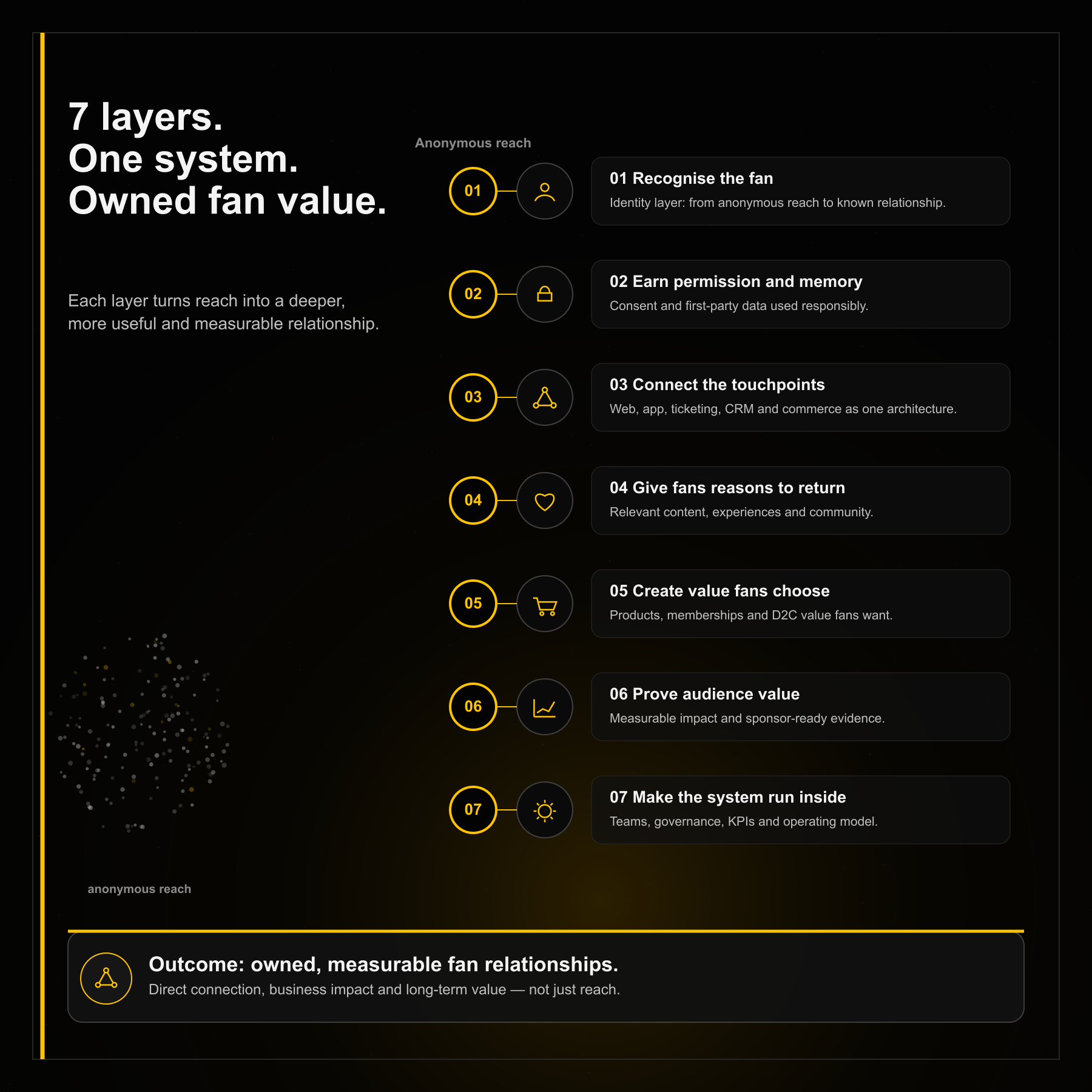
The 7 layers of fan relationship management
Fan relationship management becomes useful when it stops being a tool conversation and becomes an architecture question. Identity, consent, data, platform, engagement, monetisation, sponsorship and operating model have to work as one system.
The Fan Relationship System connects identity, consent and data, platform, engagement, monetisation, sponsorship and operating model into one relationship architecture.
Diagnostic path
Start with a free fit conversation. If the system question is clear, move into a paid diagnostic, executive review and focused advisory or workshop work.
The 7 Layers.
Each works independently. Together they are the system.
A Fan Relationship System is only as strong as its weakest layer. Below is what each layer actually contains, why it sits where it does in the architecture, and what becomes impossible if you skip it.