
Generative Engine Optimization Is Not Enough for Product Brands
On this page
Generative engine optimization is useful language. It names a real shift: brands increasingly need to be understood by AI systems that answer, compare and recommend before a website click happens.
But for product brands, the phrase can also hide the larger problem.
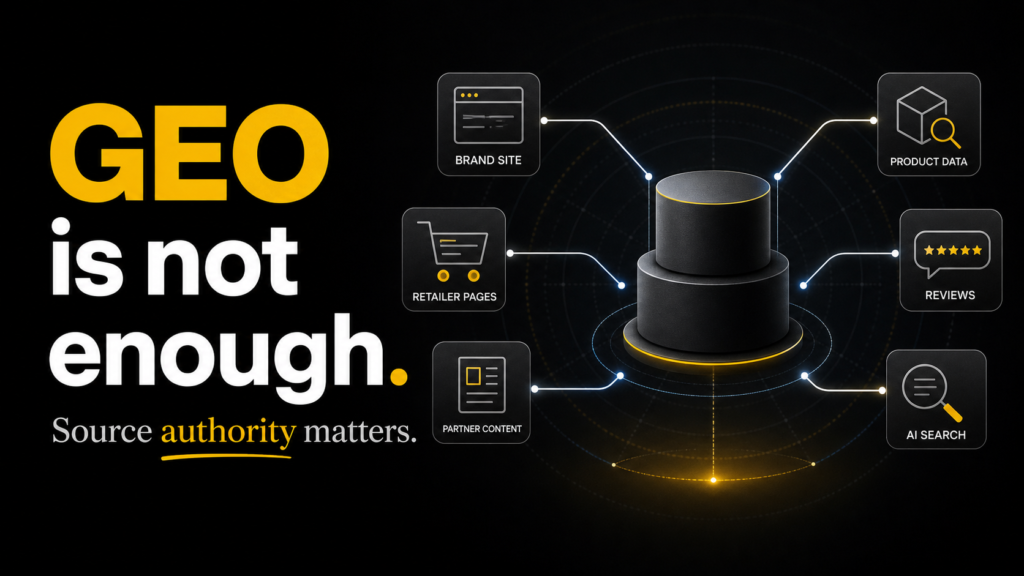
The product is not represented by one page. It is represented by an ecosystem.
AI systems do not only learn from your website. They can learn from retailer pages, partner content, marketplaces, reviews, product feeds, technical documentation, media coverage and the way other sources describe the category.
Generative engine optimization starts with sources, not prompts.
Most discussion around GEO quickly becomes tactical: write clearer pages, structure content, answer questions, use schema, become quotable.
That is not wrong.
But it is incomplete for brands with indirect distribution, partner structures or complex product benefits. In those environments, AI search visibility is shaped by the whole information layer around the product, not only by the brand website.
If the sources are inconsistent, the answer will be inconsistent. If the product benefit is scattered across partner pages, the benefit may be flattened. If the structured product data is weak, the system may understand the category but miss the differentiation.
Product brands are often defined by sources they do not fully control.
Retailer content
Retailers often carry the product page that the customer sees first. If benefits, attributes or use cases are incomplete there, AI product discovery can inherit the gap.
Partner language
Partners may explain the same product value in different ways. That creates a source problem before it becomes an AI visibility problem.
Product data
Structured product data, feature taxonomies and use-case logic help machines understand what the product is, why it matters and when it should be recommended.
GEO is not the full operating model.
Generative engine optimization, answer engine optimization, ChatGPT SEO and LLM SEO all point to the same market movement: search is becoming more synthetic, more conversational and less dependent on a classic list of blue links.
But product brands need more than a new acronym.
They need to decide which sources should define the product, which claims must be consistent, which proof should be machine-readable, which partner pages matter, and which content gaps distort the way AI systems explain the brand.
That is why Brand & Story frames the broader work as AI Discovery Readiness: the content, data, authority and workflow architecture that makes a brand visible, understandable and citable in AI-mediated search, recommendation and purchase decisions.
The next visibility layer is not only content. It is product meaning.
For product ecosystems, AI brand visibility depends on whether the important parts of product meaning are clear enough to be retrieved, compared and reused.
- What the product is and which category language should define it.
- Which benefits are proven, not only claimed.
- Which use cases, audiences and buying situations matter.
- Which partner, retailer or marketplace pages are likely to shape the answer layer.
- Which structured product data, schema and source signals are missing.
- Which content needs governance because inconsistent partner language creates discovery risk.
For brands with indirect distribution, AI search visibility is not just a marketing question. It is a product-data, source-authority and partner-content governance question.
Tools can monitor the problem. They do not define the strategy.
AI visibility tools can be useful. They can test prompts, track mentions and show which sources appear in answers.
But the first strategic question is usually earlier.
What should the system understand about the brand? Which sources should be authoritative? Which product claims need proof? Which partner pages are commercially important? Which gaps would make an AI answer technically correct but strategically weak?
Without that architecture, measurement becomes a dashboard around an unclear problem.
From generative engine optimization to AI Discovery Readiness.
The practical starting point is not to chase every AI platform. It is to map the discovery layer around the brand and decide where the product is misunderstood, under-explained or invisible.
An AI Discovery Audit should therefore look at prompts, sources, product information, structured data, partner content and governance together.
If your brand depends on retailers, partners, marketplaces or product ecosystems, start with the readiness question: can AI systems understand the value you actually create?
Explore AI Discovery ReadinessQuestions about GEO and AI Discovery Readiness.
What is generative engine optimization?
Generative engine optimization is the practice of making content easier for generative AI systems to understand, retrieve, cite or use in answers. It overlaps with SEO, content architecture, structured data and source authority.
How is generative engine optimization different from SEO?
SEO traditionally focuses on visibility in search results. Generative engine optimization focuses on whether AI systems can use a source inside generated answers, comparisons or recommendations. Both matter, but AI-mediated discovery adds a stronger source and answer layer.
Why is GEO not enough for product brands?
Product brands are often represented by an ecosystem of sources: brand pages, retailers, partners, marketplaces, reviews and product feeds. If those sources are inconsistent or incomplete, AI systems may misunderstand the product even when the brand website is optimized.
What does structured product data have to do with AI search visibility?
Structured product data helps systems understand attributes, benefits, use cases, category relationships and availability. It makes important product meaning less dependent on loose marketing copy.
What is AI Discovery Readiness?
AI Discovery Readiness is Brand & Story’s advisory approach for making brands, products and ecosystems visible, understandable and citable in AI-mediated search, recommendation and purchase decisions.
Can brands control how AI systems describe their products?
No brand can fully control AI answers. But brands can improve the source conditions: clearer product architecture, stronger authority, structured data, better partner content and ongoing monitoring.