
A Fan Can Be Reachable Everywhere and Owned Nowhere
On this page
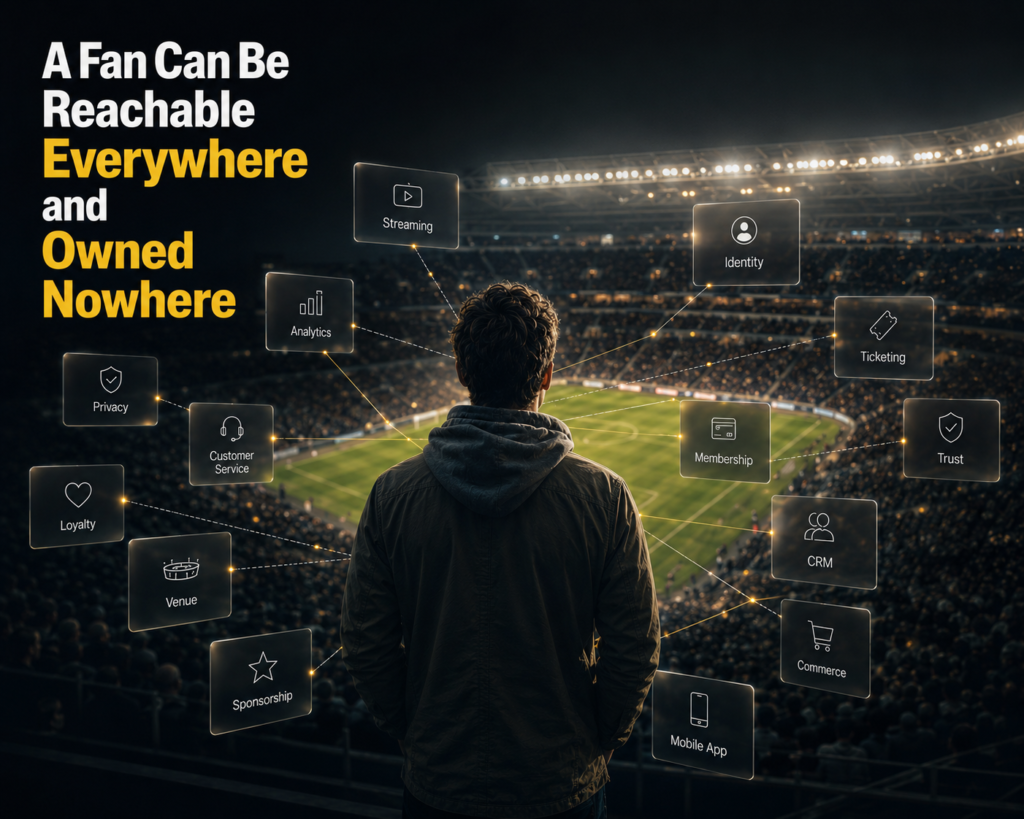
Sport has never had more ways to touch a fan. The same person can stream the match, follow clips on social, buy through a ticketing partner, enter the stadium through an app, receive a sponsor offer and appear in several dashboards by Monday morning. That sounds like progress, and sometimes it is. But it also creates a quieter problem: the fan relationship can break in the gaps between those systems.
A fan can be reachable everywhere and owned nowhere.
This is the missing question in fan relationship management. Not whether a club, league or federation has enough data. Most serious organisations have more data than they can use well. The harder question is whether the relationship survives the journey across media, identity, venue, service, commerce and trust. Call it relationship continuity.
Fan relationship management needs relationship continuity.
Relationship continuity is the ability to recognize, serve and retain a fan across the moments where the relationship changes hands.
That definition matters because the modern sports fan rarely moves through a clean owned journey. Rights are split across platforms. Data is collected by vendors, agencies, ticketing systems, sponsors and media partners. Service failures happen in emotional moments. Venue experiences are physical and digital at the same time. Personalization gets more powerful just as privacy expectations become less forgiving.
None of this means platforms are bad, partners are bad or data is bad. That would be the easy, and wrong, version of the argument. Fragmentation can create revenue, expand reach, make sponsorship more measurable and make content more accessible. It can also make the relationship harder to hold together.
The first break is access.
Streaming has given sports more distribution options, but it has also made watching a favorite team feel like a small administrative task.
Hub Entertainment Research, reported by TVTechnology, found that sports remain a powerful reason for fans to subscribe to streaming services. The same research also found that many fans dislike the experience of using several services in one season, and that more than half said finding the sports they want had become harder than a year earlier.
AP-NORC polling points in the same direction from a different angle: fans are juggling cable, sports-only streaming services, seasonal subscriptions and password-sharing. Cost is part of the frustration, but cost is not the whole story. The real relationship question is what happens when the fan has intent, emotion and willingness to pay, but the path to the event is fragmented.
A rights-holder may still monetize the access. That does not mean it owns the relationship.
The second break is identity.
The fan graph is becoming one of the more important control points in sport. Not because it is fashionable to say “data”, but because the entity that connects media behavior, commerce, engagement, attendance and loyalty starts to understand the market in ways that a single club database may not.
Omnicom’s Acxiom Fan Graph is a useful signal. The Economic Times described the platform as connecting data across media, commerce and consumer engagement, and noted the fragmentation of fan intelligence across streaming services, social media, fantasy sports, ticketing systems, retail, loyalty programs and live events.
That does not make external fan graphs a problem by definition. For brands and sponsors, they may be extremely useful. For rights-holders, the strategic question is sharper: if someone else connects the fan journey more effectively than you do, who is really learning from the relationship?
First-party data helps, but it is not a magic phrase. It matters only if it improves the organisation’s ability to recognize and serve the fan across the journey.
The third break is service.
AI in sport is often discussed as a content engine: more clips, more personalization, more automated output. The less glamorous use case may matter more.
Formula 1’s work with Salesforce is interesting here because the example is not abstract. TechRadar’s reporting describes F1 using Salesforce across offerings such as F1 TV, esports and fantasy, and discusses customer-service moments such as a fan trying to reset a password minutes before a race.
That is not a minor operational detail. In sport, the service moment is emotional. A password reset before kick-off is not the same as a password reset for a utility bill. The fan is not just trying to access an account. The fan is trying not to miss the thing they care about.
This is where fan relationship management becomes less about campaigns and more about recovery. The relationship is tested when the system fails.
The fourth break is the venue.
The stadium used to be the purest owned environment. The fan was present, emotional and directly reachable.
It is no longer purely physical. Deloitte’s WSJ-sponsored analysis reported that many fans want access to the same statistics, analysis and replays in-venue that they get at home, while a significant share also reported difficulty using mobile phones as desired at live events because of connectivity.
There is a tension here. Nobody should turn a live match into a worse version of a second screen. But venue technology is not a gimmick when it solves actual friction: entry, navigation, replays, payments, accessibility, connectivity, offers and post-match continuity.
If the fan is physically present and digitally frustrated, the relationship break is happening in the most valuable environment the rights-holder has.
The fifth break is trust.
The frontier gets more delicate when the data moves closer to emotion. Academic work around the 2025 DFB Cup final used smartwatch data to model emotional and physiological fan reactions during a high-stakes match. Separate research on location data in personalization shows the familiar trade-off: richer context can improve targeting in some situations, especially when little behavioral history exists, but it also raises privacy questions.
For sport, this is not a distant thought experiment. Fan emotion is commercially valuable. It is also personal. Knowing when supporters are excited, stressed, present, receptive or disappointed could help design better experiences and better sponsor propositions. Used badly, it would feel invasive very quickly.
The next fan metric may be emotional intensity. The next fan risk is assuming permission.
The useful audit question.
The strongest objection to all of this is fair: fragmented ecosystems often exist because they create money. Broadcast deals, sponsor integrations, ticketing partners, media platforms and data products are not going away because a consultant would prefer a cleaner journey.
Nor should they. The point is not to romanticize an old direct relationship that no longer exists. The point is to measure what fragmentation costs.
Revenue can rise while continuity falls. Reach can expand while identity weakens. Personalization can improve while trust becomes more fragile. A sponsor can get more inventory while the rights-holder gets less clarity about the fan.
That is why relationship continuity is a useful KPI for fan relationship management. It asks a more operational question than “Do we have data?” and a more strategic question than “How many people did we reach?”: where does the relationship break first?
For some organisations, it breaks at access. Fans cannot reliably find or afford the product. For others, it breaks at identity. The fan is visible to partners but not truly known by the rights-holder. Sometimes it breaks in service, when the system fails at the emotional moment. Sometimes it breaks in the venue, where digital utility lags behind fan expectation. And sometimes it breaks at trust, when the data exchange asks for more than the fan feels they received.
The answer will be different by sport, market and business model. That is exactly why it is worth asking.
If your organisation has reach, content, sponsors, ticketing, data or digital tools but still lacks a direct fan relationship system, the first step is not another platform decision. It is a system diagnosis.
Find where your fan relationship breaks firstRelationship continuity: FAQs.
What is relationship continuity in fan relationship management?
Relationship continuity is the ability to recognize, serve and retain a fan across fragmented touchpoints such as media, ticketing, venue, service, commerce, sponsors and data partners.
Why does fan relationship management need more than first-party data?
First-party data is useful only if it improves the fan journey. A sports organisation can collect more data and still fail to recognize or serve fans across broken access, identity, service, venue and trust moments.
How can sports organisations audit relationship continuity?
A practical audit starts by mapping where the fan relationship changes hands: streaming access, ticketing, login, CRM, venue app, sponsor activation, service recovery and consent. The first priority is the break that creates the highest fan friction or the greatest loss of strategic control.
Source notes.
This article draws on sports streaming research, AP-NORC polling, reporting on sports fan graphs, Formula 1’s service and CRM infrastructure, in-venue technology research and academic work on fan emotion and privacy trade-offs.
The argument is not that fragmentation reduces overall sports demand, or that partners and vendors are negative by default. The safer reading is that fragmentation creates a relationship-continuity risk that should be measured alongside reach, revenue and engagement.
- Hub / TVTechnology on sports streaming fragmentation: TVTechnology.
- AP-NORC on sports viewing cost and complexity: Associated Press.
- Omnicom / Acxiom Fan Graph coverage: Economic Times.
- First-party data after Google’s cookie reversal: Vogue Business.
- First-party and server-side tracking research: arXiv.
- Formula 1 CRM/AI fan engagement case: TechRadar.
- In-person sports technology: Deloitte / WSJ.
- Football fever wearable study: arXiv.
- Privacy-utility trade-off in personalization: arXiv.