
The Tour de France Is Full of Emotion. AI Can Help More Fans Understand It.
On this page
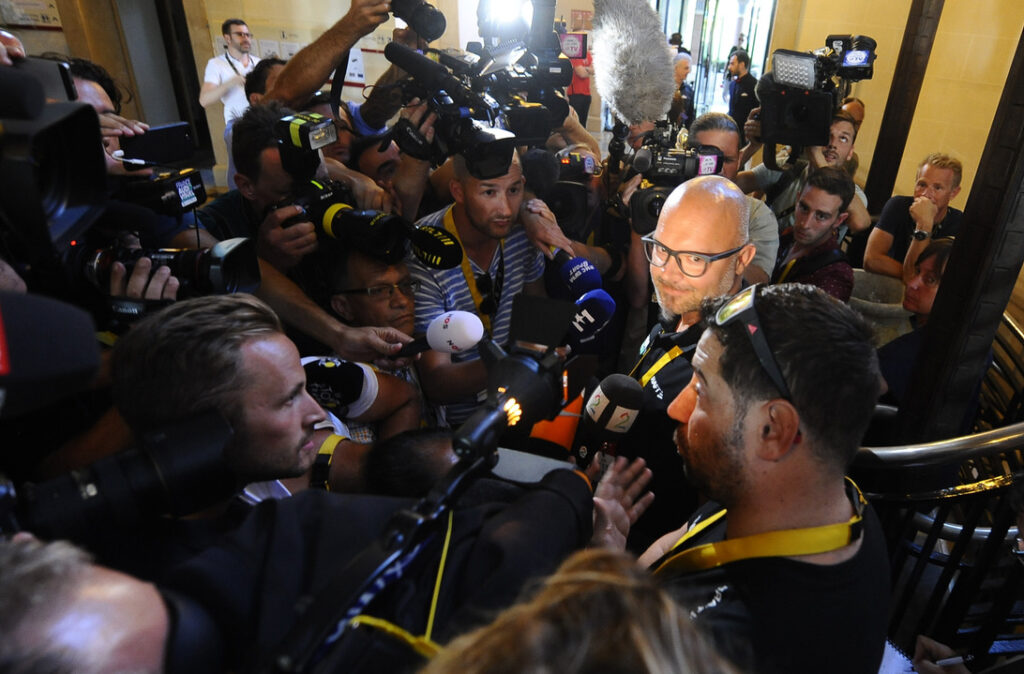
At the Tour de France, I experienced both ends of the emotional scale. In 2017, Peter Sagan’s disqualification became one of the biggest professional challenges I had faced at the race. A year later, he won Stage 2 and put BORA-hansgrohe into the yellow jersey for the first time. One moment was brutal, the other euphoric. Both explained why fans love the Tour: it is never only one story.
The most interesting use of AI at the Tour de France begins with that distinction. The race does not need technology to manufacture emotion. It needs products that help more people understand why a moment matters enough to feel it.
Cycling’s complexity is part of its magic. It is also one of its biggest onboarding problems.
What AI at the Tour de France should actually do.
A newcomer does not merely have to follow the rider who wins the stage. There is the yellow jersey, the points classification, the mountains classification, the young-rider competition, breakaways, team tactics, time gaps, terrain, domestiques and the small matter of understanding why a rider apparently going backwards may still be doing exactly the right job.
The Tour does not suffer from a content shortage. During the 2026 race, A.S.O. said its social team would publish roughly 200 pieces of content a day. The official Tour accounts generated 1.3 billion video views in 2025, while the website and app attracted more than 40 million unique visitors and 140 million sessions. The scarce resource is not material. It is comprehension.
That makes explanation a more useful AI problem than generation. More synthetic copy will not make the race easier to follow. A better product might.
An explanation product, not a replacement storyteller.
A.S.O. and Capgemini describe Inside My Race as a personalized, near-real-time experience built around up to four riders selected by the fan. It combines live information such as position, speed, gaps and terrain with stage history, interviews, expert insight, photos, video and other material created by the Tour’s editorial teams.
That last point matters. The useful role for AI here is not to replace the writers, photographers, commentators or race experts who understand the event. It is to assemble their work with live data around a fan’s immediate question: what is happening to the riders I care about, and why?
The product is also meant to adjust the level of detail for committed followers and people newer to cycling. If it works as intended, the same race can remain gloriously complicated without requiring every viewer to arrive with a decade of tactical knowledge.
There is a broader product principle in that design. Personalization is not valuable because it makes every screen look different. It is valuable when it reduces the distance between curiosity and understanding.
One million members, but not yet one proven system.
A.S.O. also says the Tour de France Club has passed one million members. The free Club gives registered fans access to content, games, Fantasy, votes, competitions and selected Race Center features. Strategically, it is easy to see why that matters: an identifiable audience gives a rights-holder more opportunities to learn, personalize and continue the relationship beyond anonymous reach.
It is equally easy to run too far with the evidence. A.S.O.’s public material presents the Club and Inside My Race as parts of its wider digital fan experience, but it does not establish that the Club identity system technically powers the new AI product. Nor does it show that one million registrations equal one million active or commercially valuable relationships.
The two developments are therefore best read as complementary product capabilities, not as proof of an integrated system. Identity can make a fan recognizable. Explanation can make the race more accessible around that fan’s interests. The strategic opportunity lies in connecting those capabilities without breaking relationship continuity. The public evidence does not yet tell us how far A.S.O. has gone.
The next useful announcement would contain different numbers.
Feature launches tell us what a product can do. They rarely tell us whether fans found it useful. The first deployment of Inside My Race deserves attention, but the decision-grade questions begin after launch: how many people used it more than once, which explanations kept newcomers engaged, whether experienced fans wanted a different level of detail, and whether the product changed return visits before, during or after a stage.
The Club raises a similar set of questions. How many members remain active outside the three-week Tour window? Which services create repeat use? Does registration improve the fan experience before it improves the database? And can A.S.O. connect participation, content choices and product use in a way that helps fans rather than simply producing a larger audience file?
None of those missing numbers invalidates the product direction. They simply mark the boundary between an interesting capability and a proven fan or business outcome. That boundary matters, especially in an AI market where a feature description can acquire the tone of a victory lap before the first user has completed one.
Complex sports should not be simplified into boredom.
The goal is not to flatten cycling until every tactical decision fits into a push notification. The strange vocabulary, shifting classifications and team-within-an-individual-sport logic are part of what makes the Tour worth following. Good explanation does not remove that depth. It gives a new fan a route into it.
That makes this relevant well beyond cycling. Motorsport, sailing, cricket, baseball, biathlon and many other sports contain moments whose importance is obvious to an expert and invisible to everyone else. AI can be useful when it knows the difference between explaining that moment and inventing a new one.
The product question for rights-holders is therefore not simply, “Where can we add AI?” It is more demanding: which part of our sport is unnecessarily difficult to understand in real time, which trusted sources can explain it, and how do we learn whether that explanation created enough value for the fan to return?
The Tour already owns the emotion. The interesting work is opening the door to it.
If your sport has abundant content but a fragmented or difficult fan journey, the first decision should not be which AI feature to buy. It should be which fan problem is actually worth solving.
Discuss the product and relationship questionAI at the Tour de France: FAQs.
What is Inside My Race?
Inside My Race is a 2026 Tour de France digital experience developed by A.S.O. and Capgemini. It combines live race data, editorial material and selected riders to create personalized, near-real-time race explanations across Tour web and mobile platforms.
How is AI used at the Tour de France?
Inside My Race uses AI to interpret live race information and combine it with Tour editorial content. Fans can follow up to four selected riders and receive context around position, speed, gaps, terrain, history and key race moments.
Does the Tour de France Club login power Inside My Race?
A.S.O.’s public 2026 material presents the Club and Inside My Race as parts of the wider digital fan experience, but it does not establish a technical integration between Club identity and the AI product.
Why is explanation a valuable AI use case in sport?
Many sports are difficult for newcomers to understand in real time. AI can add value when it uses trusted data and editorial sources to explain tactics, context and significance without replacing the human storytelling that gives the event meaning.
Source notes.
The 2026 product and audience claims in this article come from A.S.O. and A.S.O./Capgemini announcements. They describe audience scale, product features and stated ambition. They do not provide usage, retention, conversion or commercial-impact results for Inside My Race, and they do not establish that Tour Club identity technically powers the product.
The personal 2017 and 2018 context is Ralph Scherzer’s firsthand account. Official Tour archives confirm Peter Sagan’s 2017 disqualification and his 2018 Stage 2 victory and yellow jersey; contemporary reporting recorded Sagan describing it as the first yellow jersey for BORA-hansgrohe.
- A.S.O. on the Tour’s 2026 fan experience, digital audience and one million Club members: How to follow the Tour?
- A.S.O. and Capgemini on the design and stated purpose of Inside My Race: Inside My Race launch
- Official Tour archive on Peter Sagan’s 2017 disqualification: A palette of colours
- Official Tour archive on Sagan’s 2018 Stage 2 victory and yellow jersey: Peter Sagan takes stage win and yellow jersey
- Contemporary report carrying Sagan’s statement that it was BORA-hansgrohe’s first yellow jersey: Bicycling Australia