
Sports Data Is Big Business. Why Cycling Still Struggles.
On this page
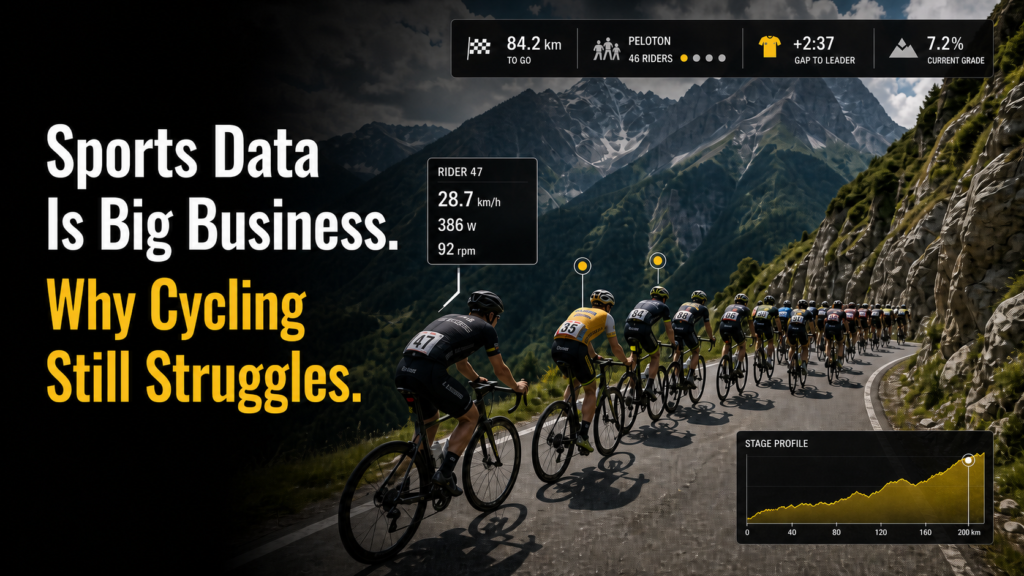
On a good day, a cycling broadcaster can show a rider’s power, speed and cadence while the race is still unfolding. On another Sunday, the same numbers may be missing, produced by a different partner or available for a different group of riders.
The problem is no longer whether the data can be collected. Velon settled that years ago. The missing piece is a cycling data product that a broadcaster can integrate once, use across the season and teach fans to expect.
Velon proved the feature. Cycling still needs the product.
Velon has already solved the most visible part.
Velon’s system captures live speed, power, cadence, heart rate, gradient and position from selected riders at major professional races. The data appears in its Race Centre, on digital channels and in broadcast graphics. When it works, it does something cycling badly needs: it makes an invisible effort visible.
This is not a small achievement. Road racing is difficult to transmit from, the mobile signal can disappear in remote terrain and the device has to survive weather, vibration, bike changes and the rest of professional cycling’s daily chaos. Velon has shown that live rider data can travel from the bike to the viewer quickly enough to improve the story of a race.
That should end one argument. Technology is not the fundamental blocker. The harder question is why a proven capability has not become one dependable product across the calendar.
A brilliant race feature is not a season product.
Velon describes its system as operating at major professional races. Its public partnership history also shows why the distinction matters: agreements have been made with specific organisers and for defined groups of races. The available riders, metrics and distribution can therefore depend on who is participating, which technology is in use and what a particular event has agreed.
That does not make the data less valuable. It makes it difficult to turn into a repeatable broadcaster proposition. A network does not want to rebuild the integration, graphics logic and commercial package every time the peloton crosses a border or the race organiser changes.
Rights fragmentation is only half the explanation. Even when data is available, it can stop at delivery: a power number appears on screen, but too little is invested in the visual language, derived metrics and editorial formats that would make it useful every week. That is understandable when the underlying feed is temporary. It is also why the temporary feed never quite becomes a product.
Fans experience the same problem from the other side. A live watt figure can be fascinating, but it does not create a habit if the metric, rider and interface vanish at the next event. Consistency teaches an audience what to look for. Inconsistency turns every innovation into another impressive demo.
What broadcasters need is boring in exactly the right way.
The glamour sits in a climber’s power number on the final ascent. The product sits underneath it: common rider and race identifiers, stable definitions, historical context, availability rules, reliable delivery and an interface that behaves the same way next week.
That is how mature sports data services are sold. Their value is not one spectacular metric. It is the ability to combine live, cumulative and historical data through a stable API or set of broadcast tools. Producers can build graphics, commentators can compare performances and digital teams can publish a race centre without renegotiating the meaning of every field.
Cycling already has strong results databases and deep specialist knowledge. It also has occasional live telemetry that other sports would envy. What it lacks is the boring connective tissue that turns both into broadcast data a buyer can plan around.
The best statistics answer questions the camera cannot.
The opportunity is not to cover a broadcast in numbers until it resembles a trading terminal. It is to answer the questions that make cycling difficult to follow. A rider can lose time while doing a perfect job, spend the day in the wind so a teammate does not have to, or burn a decisive amount of energy long before the television director notices.
The Belgian classics make the first gap obvious. A race can split into a chain of small groups, while the available television motorbikes can only show a fraction of them. If the rider you follow disappears from the picture, a live group map should still be able to answer a basic question: where is my rider, who is around them and how far are they from the front?
A sprint stage offers a more ambitious product. Instead of showing only top speed or a raw watt figure, a broadcast could estimate which sprinter reached the finale most efficiently: who spent the least avoidable energy, stayed protected in the slipstream and avoided repeated accelerations before the decisive effort. That cannot be reduced to the lowest average watts. Terrain, speed, rider profile, positioning and race role all matter. But a transparent energy-conservation metric would tell fans far more than another isolated number.
The fight for the breakaway creates a third story before the television race has even settled. It can take 50 kilometres or more before the right group escapes, with some riders joining attack after attack. An attack ledger could show who has tried, who made the eventual move and how much effort each rider invested to get there. Across a season, the same events could become durable cycling statistics: attack attempts, successful breakaway entries, kilometres at the front and the riders who most consistently shape a race before the result sheet notices them.
This is where the idea connects to the Tour de France’s recent work on explanation. As argued in our analysis of AI at the Tour de France, the sport does not need synthetic drama. It needs better ways to explain the drama already on the road. A consistent data layer would give that product reliable material.
The answer is not to publish every watt.
Teams are right to protect information that reveals physiology, health, preparation or tactics. Riders are right to expect meaningful consent and privacy controls. Even a current ITA feasibility study using longitudinal power data has to address device calibration, scientific comparability, legal basis, processing methods and data-sharing protocols.
Those constraints do not kill the product. They define it. Public timing, position, gaps, route, gradient and historical results can form a dependable baseline. Selected cycling performance data can be delayed, aggregated or translated into transparent effort bands. Raw health and training files can remain protected.
The strategic work is not choosing between total secrecy and total disclosure. It is deciding which information can create fan value without giving away competitive or personal information.
What a cycling data product needs to deliver.
A credible first version does not require every team, every race and every power meter to produce identical cycling telemetry. It needs a common contract for the data that can be guaranteed, plus honest labels for the data that cannot.
Stable foundations
Canonical rider, team, race and stage IDs; common metric definitions; live timing, position, gaps, route and gradient; historical results and comparisons.
Clear availability
Machine-readable labels showing which optional metrics are live, delayed, aggregated or unavailable, without breaking the interface or the broadcast workflow.
Persistent distribution
One stable API and a reusable broadcast toolkit that can support graphics, race centres, commentary, archives and second-screen products.
Editorial products
Reusable visual logic for rider tracking, group formation, attack histories and clearly explained derived metrics, rather than a new one-off graphic at every race.
Rights and trust
Transparent cycling data rights, rider consent, protected data tiers, commercial permissions and a fair model for sharing the value created.
The first revenue is likely to be packaged, not magical.
There is no credible public estimate for how much money cycling leaves on the table today, and inventing one would make the argument weaker. The initial business case is more practical: a consistent product creates things that can be sold and repeated.
A broadcaster could sponsor named insight segments around rider tracking, sprint efficiency or the battle for the breakaway. A race organiser could operate a dependable race centre. A media partner could license the feed for commentary, graphics or a second screen. Teams and riders could participate in the commercial return instead of being asked to release valuable information for vague exposure.
Over time, the same layer could support personalised rider alerts, fantasy, predictions, archives and premium analysis. Its live events would also accumulate into a season statistics product, giving fans and commentators familiar records to follow rather than a fresh set of disconnected graphics at every race. None of that revenue is automatic. The important difference is that a season product can be improved, packaged and sold repeatedly; isolated race activations have to keep starting again.
No single stakeholder can finish this alone.
The UCI can define standards but does not own every commercial permission. Organisers control races and broadcast environments but not every rider’s data. Teams and riders hold access to the most interesting performance information, while timing, telemetry and media partners operate much of the technology.
One Cycling was the stress test.
One Cycling was the latest serious attempt to change that structure. Led by a group of teams and organisers, the project aimed to create a more coherent commercial model around races, media rights and shared revenue. Reports put the expected backing from SURJ Sports Investment, a company owned by Saudi Arabia’s Public Investment Fund, at roughly EUR250 million. For a sport that routinely says it lacks capital, this was not a marginal proposal.
Capital was not enough. ASO chose not to join, several teams opposed the model or stayed outside it, and the UCI refused to include One Cycling in the 2026 WorldTour calendars. The governing body said the proposal was incompatible with its governance and regulatory framework and lacked sporting coherence. It later warned that teams and organisers pressing ahead outside that framework could put licences or race registrations at risk.
That response cannot simply be dismissed as bureaucracy. The project’s detailed business model was reportedly shared only under a strict non-disclosure agreement, and a private joint venture influencing the hierarchy of WorldTour events raises legitimate sporting and governance questions. But the episode also revealed cycling’s veto map. Without the Tour de France, a unified commercial package lacks the sport’s strongest asset. Any reform that reduces ASO’s leverage is unlikely to win ASO’s support, while the UCI has every reason to defend its authority over the calendar and the teams are not united enough to force a different settlement.
Our conclusion is not that One Cycling was necessarily the right model, or that a reported EUR250 million would have fixed the sport. It is that even substantial outside capital could not align the parties around a shared long-term product. Short-term control won. The larger commercial opportunity remained fragmented.
A cycling data product therefore has to be narrower and easier to govern. It needs a neutral framework for minimum standards, rights clearance, data tiers, commercial terms and value sharing without asking every stakeholder to surrender control of the whole sport at once. Velon should be part of that conversation because it has built real capability and understands the practical failure points. It should not be mistaken for proof that the whole market has already been solved.
The sensible next step is not a universal infrastructure programme. It is a contained pilot across one race series or stage race, with a stable baseline, a small set of derived metrics, one broadcast partner, one presenting sponsor and explicit team and rider terms. Measure repeat use, editorial reuse, sponsor interaction and operational reliability before asking the entire sport to agree.
If your sport has valuable data but no repeatable product, the key question is not which dashboard to build. It is which rights, standards, partners and operating model have to align before a broadcaster or fan can depend on it.
Discuss the product and operating modelCycling data product: FAQs.
What is a cycling data product?
A cycling data product is a rights-cleared, standardised and continuously distributed service that turns race timing, position, historical results and permitted rider telemetry into repeatable broadcast, digital and sponsor experiences across a season.
Does Velon already provide live rider data to broadcasters?
Yes. Velon captures metrics including speed, power, cadence, heart rate, gradient and position at major professional races and supplies data to broadcasters and digital channels. Its public material demonstrates the capability, but does not promise universal coverage across every race and team for a full season.
Why is a race data feature not the same as a season product?
A season product needs stable identifiers, definitions, availability rules, rights, historical context and an interface or API that remains dependable from race to race. An isolated race integration can be valuable without creating that continuity.
Does a cycling data product require raw rider power and health data?
No. A useful baseline can rely on timing, position, gaps, route, gradient, historical results and transparent derived metrics. Sensitive performance or health data can remain protected, delayed, aggregated or optional.
How could a season-long cycling data product create commercial value?
It could support repeatable broadcast graphics, sponsored insight formats, race centres, second-screen experiences and licensed feeds. These are product opportunities, not proven revenue outcomes, and should be tested through a contained pilot.
Source notes.
This article distinguishes established capability from an inferred market gap. Velon’s own material is primary evidence for its system, metrics, broadcast use and operating scope. The conclusion that cycling lacks a broadly consistent season product is an analysis of the public market structure, not a claim that no cycling data can be bought or that Velon cannot expand. Rider tracking, sprint efficiency and attack-ledger examples are product concepts, not claims that standardised versions of those metrics already exist.
The One Cycling section distinguishes the public record from our interpretation. The UCI’s rejection, its stated reasons and SURJ’s relationship to PIF are documented. The reported investment size, the project’s proposed commercial mechanics and stakeholder positions come from specialist reporting because One Cycling did not publish a complete business plan. We do not claim that ASO alone killed the project, that the investment was contractually committed, or that One Cycling would have succeeded.
Commercial applications are product opportunities, not measured cycling outcomes. Comparators from larger sports-data providers show how stable live, cumulative and historical feeds can be packaged, but they do not prove the same revenue or engagement effect in cycling.
- Velon on its live rider data system, metrics, broadcast distribution and connectivity limitations: How Velon data works.
- Velon on its device partnership and live/post-race data capability: Velon partners with Insiders.
- Velon’s organiser-specific RCS Sport agreement covering defined Italian races: Velon and RCS Sport rider-data deal.
- International Testing Agency on its 2026 longitudinal cycling power-data pilot, consent process, calibration and scientific-validation questions: ITA power-data feasibility study.
- Stats Perform developer documentation illustrating a product that combines live, cumulative and historical sports data through common identifiers and API calls: STATS API developer documentation.
- Genius Sports on official live and historical data products for media, broadcast, fantasy and digital experiences: Official sports data APIs.
- The UCI’s official decision not to include One Cycling in the 2026 WorldTour calendars, including its stated governance, regulatory and sporting-coherence concerns: UCI decision on the 2026 calendars.
- Cyclingnews on One Cycling’s reported commercial ambitions, stakeholder structure and expected EUR250 million SURJ backing: What is One Cycling?.
- Cyclingnews on the UCI’s subsequent licence warning, ASO’s position and the limited public visibility of One Cycling’s business plan: UCI puts One Cycling on notice.
- PIF’s official portfolio page confirming that SURJ Sports Investment is a PIF company: SURJ Sports Investment.