
Most sports organisations have digital tools. Very few have a digital ecosystem.
That is the critical difference: between a collection of platforms — and an integrated infrastructure that knows its fans, activates them, and monetises them directly. Without algorithms as intermediaries.
A sport digital ecosystem is the technical and strategic infrastructure through which a sports organisation builds, manages and monetises digital fan relationships.
It consists of three integrated layers:
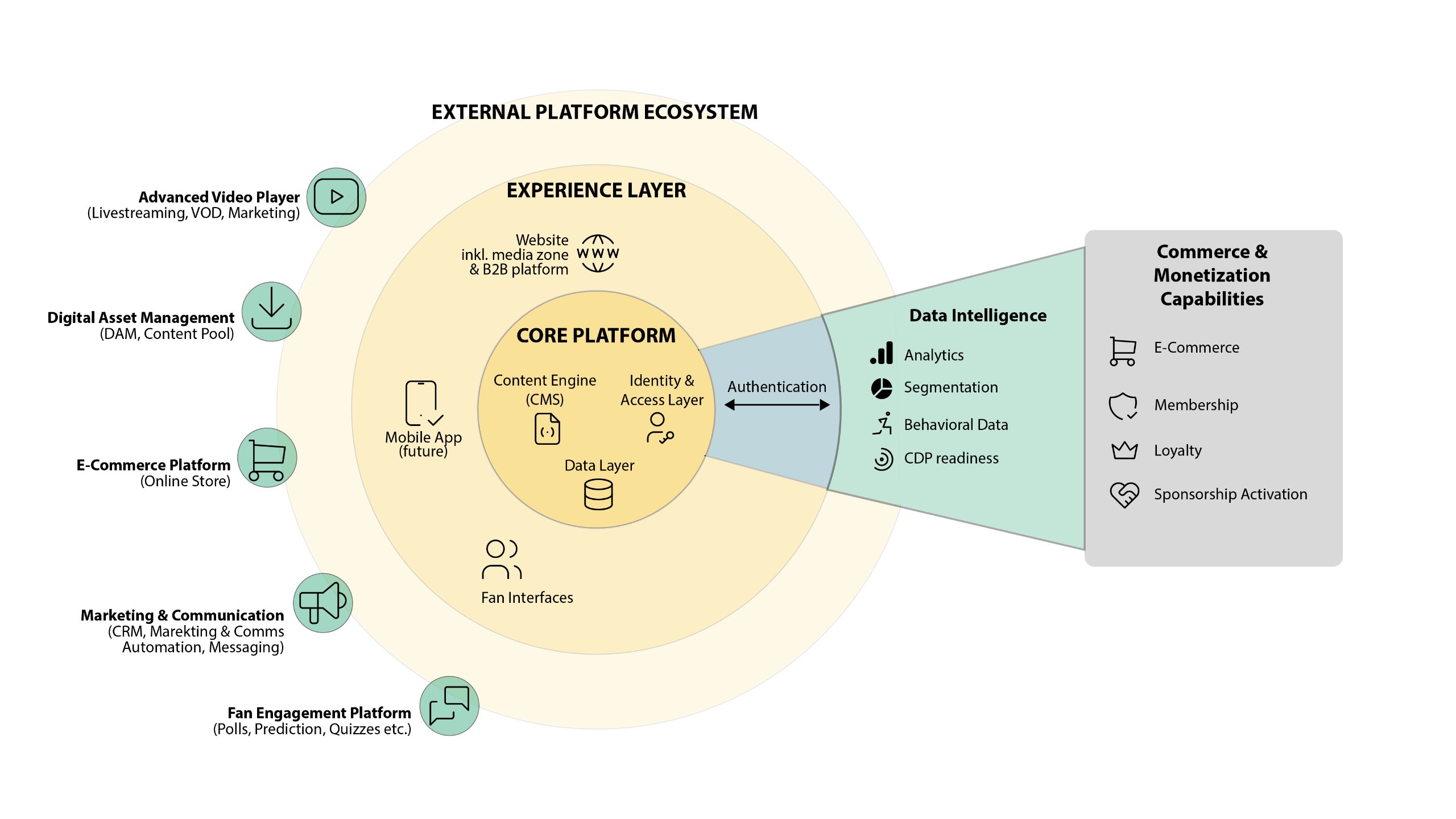
1. Core Platform — the foundation
Content engine (CMS), identity & access layer, data layer. Everything flows through here. Every fan interaction — a login, a click, a purchase — feeds back into the data layer and makes the system smarter.
2. Experience Layer — the fan interface
Website, app, media zone. What the fan sees and experiences. All powered from the core.
3. External Integrations — the extension layer
E-commerce, fan engagement, marketing automation, sports data, B2B data. Individual systems integrated into the ecosystem — not running in parallel alongside it.
What connects these layers: a shared data logic.
Reach alone is not a business model.
Social media gives you followers. Not fans. Not data. No direct monetisation potential. You reach your audience only as long as the algorithm allows it.
A sport digital ecosystem delivers what social media cannot:
This is the core of Owned Fan Relationships.
The entry point for every fan. Registration, login, consent management. Without this layer there is no data — and no ecosystem. → What is the Identity Layer?
Behavioural data, segmentation, CDP-readiness. All fan signals flow together here. The foundation for personalisation, communication and sponsorship proof.
The editorial core. Video, articles, live content — managed through one platform, distributable across all channels.
E-commerce, membership models, loyalty programmes, sponsorship activation. The economic output of a functioning ecosystem — not the starting point.
Not a CRM alone.
Not an app alone.
Not a website alone.
It is the interplay of all systems under a shared data and strategy logic. Organisations that buy systems individually and run them in parallel have tools — not an ecosystem.
Primarily for leagues, clubs and federations — wherever a sports organisation has an audience it does not yet know, reach or monetise directly.
But the logic does not stop at sport.
A sport digital ecosystem is not a sports invention.
The underlying logic — know your audience, own your data, monetise directly — applies to any organisation building direct relationships with an audience. Brands, media companies, live event organisers.
The context differs. The infrastructure logic is the same.
→ How Brand & Story works with brands outside sport
It depends on your starting point. Greenfield projects — building from scratch — are more capital-intensive than incremental development on existing infrastructure. The first step is always an assessment: what is in place, what is missing, where are the most critical gaps?
A complete ecosystem setup: 12–24 months. First measurable results — fan registrations, data KPIs, conversion — are typically visible within 60–90 days when the build is structured from the start.
For leagues, clubs and federations that have a website and initial digital fan touchpoints — but no integrated data logic behind them. Also for organisations that notice their systems are running side by side rather than working together.
With the Identity Layer. That is the foundation. Without it there is no data, and without data there is no ecosystem.
Want to know where your organisation stands today?
→ 30 minutes · No cost · No pitch
Book a conversation