
Monaco Does Not Need More Exposure. So Why Is It Hosting La Vuelta?
On this page
In 2018, I was in Israel when the Giro d’Italia became the first Grand Tour to start outside Europe. The first training ride did not feel historic. It felt strange: desert, heat, and almost none of the visual language that normally tells you a Grand Tour is about to begin. It was a break with cycling tradition, without yet being obviously good or bad. What was clear was that the Giro had crossed more than a border. It had reached a turning point in how a Grand Tour could use geography. Looking back, that strange first ride also made a different business model visible: a country using somebody else’s race to tell a story about itself, an organiser turning geography into revenue, and teams making the whole thing work.
La Vuelta Monaco 2026 makes that business model visible again. Monaco hardly suffers from a shortage of global exposure. It already has Formula 1, the Monte-Carlo Masters, a Champions League football club and one of the most recognisable place brands in the world. So why buy another international sports event?
A Grand Depart is not one product. Its value depends on what the host is trying to change.
What La Vuelta Monaco 2026 is really selling.
The standard explanation is exposure. A city or country pays to host the start, television sends the landscape around the world, visitors arrive and everyone counts hotel nights. That is part of the product, but it is not the whole one.
An international Grand Depart is at least a three-sided deal. The organiser brings a global event, broadcast distribution and route storytelling. The host brings territory, infrastructure, public space, local activation and money. The teams bring the riders, staff, bikes, vehicles and technical operation without which there is no television product to sell. What changes from one deal to the next is the strategic job the race is hired to do, and how unevenly its value and costs are distributed.
Israel, Utrecht and Monaco are useful precisely because they are not alike. The comparison is not a league table of event ROI. It is a look at three different purchases made through broadly the same cycling product.
Israel bought reframing.
The Giro’s opening three stages ran from Jerusalem to Jerusalem, Haifa to Tel Aviv, and Be’er Sheva to Eilat. The official race archive called it the first time the Giro had crossed beyond Europe. That alone made the start news before a wheel had turned.
A peer-reviewed study in Tourism Economics later examined the announcement’s effect on listed Israeli tourism firms. It found an increase in their market value on the announcement day. The authors’ interpretation was not that the race had already delivered tourists. It was that the attention around the announcement improved expectations about country image and incoming tourism.
The television pictures hid an extraordinary piece of logistics. A Boeing 747 carried the 22 teams’ bikes and equipment from Italy to Israel: roughly 880 bikes, 2,700 wheels and about a tonne of material per team. After the third stage, two cargo flights moved the equipment back to Italy while four charter flights took the riders and race caravan to Sicily. The Giro restarted in Catania on Tuesday. There was no time to drive the normal operation back across Europe.
From inside a team, that meant running two versions of the race at once: a working fleet and technical setup in Israel, and another operation already waiting in Italy for Stage 4. Contemporary reporting said teams received higher race fees to cover the extra expense. My experience was less generous than that sentence sounds. The compensation was modest compared with the duplication, staffing pressure and risk the teams absorbed.
At the same time, Italian trade reporting said the hosting rights paid by Israel contributed to RCS Sport’s Giro revenue, forecast at EUR 44-48 million for 2018. There is no public distribution table that shows exactly how the hosting payment moved through the race. The direction of the model is nevertheless clear: the glamour sat at the start line, the host fee flowed to the organiser, and the teams delivered the sporting product while carrying much of the operational strain.
That distinction matters. The defensible claim is not that three stages repaired a national reputation or produced a proven long-term tourism return. Public evidence does not establish that. The useful point is that the start was designed as a reframing event, and that its value was not shared in the same way by every party involved. Cycling supplied movement, landscape and international attention; Israel used them to offer a different picture of the country.
Utrecht bought participation.
Utrecht treated La Vuelta less like a television postcard and more like a civic programme with a race attached. In the 100 days before the start, municipalities, businesses and sports organisations ran 318 supporting activities. The city’s final evaluation reported 60,913 participants and 318,969 visits to those activities.
Across the team presentation, team time trial and the following two stages, the event recorded 957,700 visits. That figure should not be read as 957,700 unique people. Utrecht University also calculated EUR 17.6 million in total economic impact, while the project closed with a positive result of more than EUR 300,000.
The interesting asset was not only the broadcast. Utrecht built local behaviour around the event and measured it. The Grand Depart became a reason to get people moving, bring organisations together and reinforce the city’s cycling identity. Exposure was still useful, but participation was part of the product rather than a hopeful side effect.
Monaco is buying distinction.
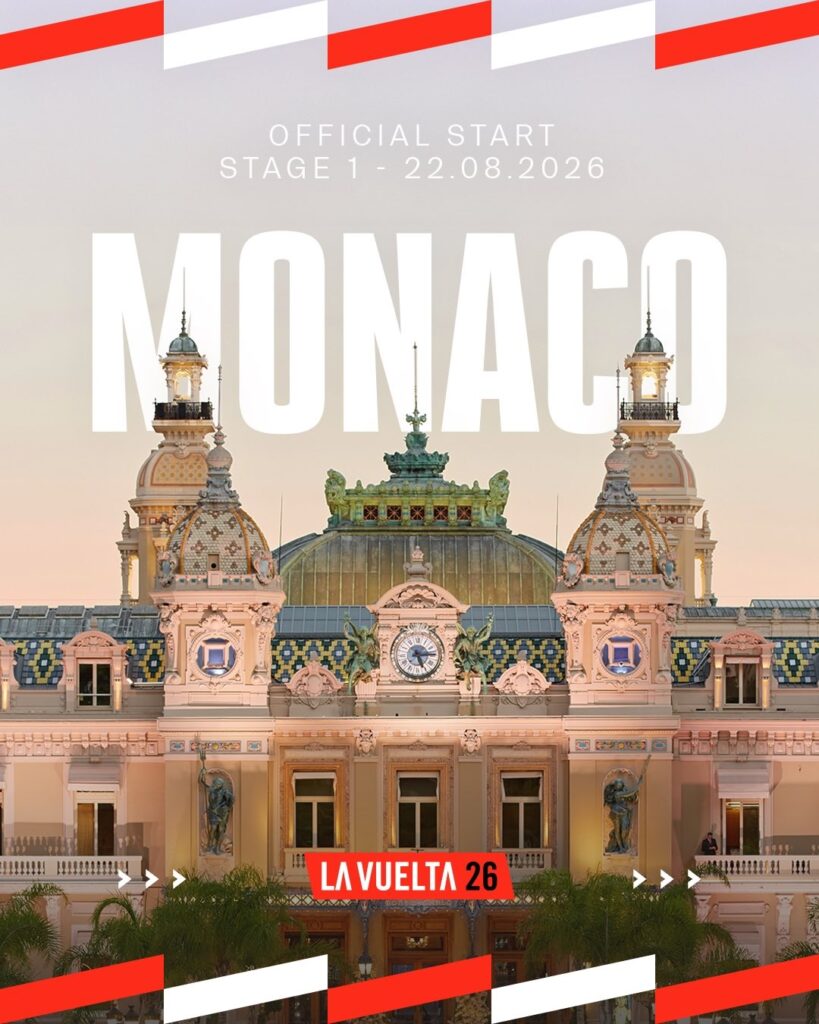
On 22 August, La Vuelta will begin with an individual time trial through Monaco. The following day, Stage 2 will also start in the principality. The route matters, but the line in the event portfolio matters more: Monaco will become the first place to host the opening stage of all three Grand Tours, after the Giro in 1966 and the Tour de France in 2009.
For a place already saturated with recognition, more raw awareness is a weak explanation. The safer strategic reading is distinction. Monaco is adding a rare credential to a portfolio built around premium international sport, and La Vuelta gets a stage that can borrow the Casino, the Grand Prix finish line and the principality’s visual shorthand.
This is an interpretation, not an impact result. The race has not happened yet, and there is no basis for claiming tourism uplift or commercial return. But the design makes the intended signal difficult to miss: Monaco is not asking the world to discover it. It is reminding the world which events belong there.
Exposure is the beginning of the brief, not the answer.
Event-impact studies often tempt us into one large number. The problem is not that economic impact, attendance or media reach are useless. It is that they answer different questions and can conceal different denominators. Visits are not unique visitors. Market expectations are not realised tourism revenue. A pre-event distinction is not a post-event return. Organiser revenue is not team economics.
The better evaluation starts before the route announcement. What is the host trying to change: awareness, image, participation, visitor behaviour, investment perception, event-portfolio status or something else? Which audience should change its mind or behaviour? What evidence would distinguish a temporary broadcast spike from a strategic result?
A serious evaluation also needs three scoreboards. What did the host change? What did the organiser earn? What did the teams have to duplicate, source, staff and risk in order to deliver it? The first two parties usually own the brief and the contract. The third supplies the show, but is too often treated as a cost line rather than a stakeholder in the value created.
The same discipline applies to sport organisations and sponsors. A large event can create attention almost by definition. The harder work is deciding which part of that attention should become a durable asset, and whether the people carrying the delivery burden share fairly in the upside.
Israel bought reframing. Utrecht bought participation. Monaco is buying distinction. None of those strategies can be judged with the same scoreboard, which is exactly why the word “exposure” is too small for the deal.
If your event, sport or partnership creates attention but the strategic value remains hard to define, the first step is to clarify what should change, for whom, and how that change will be measured.
Discuss the strategic value modelGrand Depart host strategy: FAQs.
Why is Monaco hosting La Vuelta in 2026?
Monaco has not published one complete ROI case. The event design gives it a distinctive sport-portfolio milestone: in 2026 it becomes the first place to host the opening stage of the Giro d’Italia, Tour de France and La Vuelta. Reading the start as a distinction and positioning asset is an editorial interpretation, not a measured post-event result.
What impact did La Vuelta 2022 have in Utrecht?
The City of Utrecht reported 957,700 event visits across four main event days and EUR 17.6 million in total economic impact. Its 100-day activation programme included 318 activities, 60,913 participants and 318,969 activity visits. Event visits should not be read as unique visitors.
Why did the Giro d’Italia start in Israel in 2018?
The 2018 Giro used three stages in Israel to take the race beyond Europe for the first time. A peer-reviewed study found that the announcement increased listed Israeli tourism firms’ market value on the announcement day, which the authors linked to country-image effects and expectations of incoming tourism. It does not prove long-term tourism ROI.
What did the Israel Grand Depart require from the cycling teams?
The 22 teams’ bikes and equipment were flown to Israel on a Boeing 747 and returned to Italy on two cargo flights, while riders and the race caravan moved to Sicily on four charters. Teams operated with equipment and vehicles in Israel while their usual buses and cars were already waiting in Catania. Public reporting said teams received higher race fees, but no public audited table shows the full team-by-team cost or compensation.
How should a host measure the value of a Grand Depart?
The host should first define the intended change, target audience and time horizon. Awareness, image, participation, tourism, investment perception and event-portfolio distinction require different metrics. Reach alone cannot show whether the strategic objective was achieved.
Source notes.
This article compares strategic uses of international Grand Depart hosting. It does not present a like-for-like ROI ranking. The cases cover different entities, objectives, periods and measurement methods. Monaco’s event is still upcoming, so its section is a strategy reading rather than an outcome evaluation. The account of team-side duplication and compensation in Israel is Ralph Scherzer’s first-hand operator perspective; the public sources corroborate the exceptional logistics, higher race fees and organiser hosting revenue, but do not provide an audited team-by-team distribution table.
- Giro d’Italia official archive on the 2018 route and the first start beyond Europe: Giro d’Italia 2018 route
- Nicolau, Sharma and Zarankin on the announcement effect for Israeli tourism firms: Tourism Economics study summary
- Cyclingnews on the Boeing 747, team equipment, parallel vehicle arrangements and reported higher race fees: Israel logistics operation
- Air Cargo Italy on the 880 bikes, cargo coordination and two return flights to Italy: Giro cargo operation
- Dailyonline on RCS Sport’s forecast 2018 Giro revenue and the contribution from Israel hosting rights: RCS Sport revenue report
- City of Utrecht on visits, economic impact and the 100-day activation programme: La Vuelta Holanda evaluation
- La Vuelta on Monaco becoming the first place to host the opening stage of all three Grand Tours: Monaco 2026 announcement
- La Vuelta route announcement for the Monaco time trial and Stage 2 start: Monaco route announcement