
Red Bull FDJ: Access, Not Ownership, May Be the Strategy
On this page
The most interesting part of Red Bull’s FDJ UNITED-SUEZ deal is not the helmet logo. It is what Red Bull did not do.
The Red Bull FDJ story is easy to read as another large brand moving into women’s sport. That reading is true, but incomplete. Red Bull has become Major Partner and Official Energy Drink Partner of FDJ UNITED-SUEZ, with its logo appearing on team helmets and the Red Bull Athlete Performance Center included in the announced partnership. What it has not announced is a takeover, a team-name change or an ownership position.
That restraint may be the strategy. Red Bull gets immediate access to one of the strongest platforms in women’s road cycling without forcing the partnership into a second Red Bull-BORA-hansgrohe model from day one.
In sport, access can be a strategic asset before ownership becomes necessary.
Red Bull FDJ is access first, not ownership on day one.
The public deal structure is important because it is smaller than some of the earlier speculation and more interesting because of it. Cyclingnews and Cycling Weekly reported Red Bull’s entry as a major partnership with FDJ UNITED-SUEZ, launched around the Tour de France Femmes, with all riders wearing branded helmets. FDJ and SUEZ remain the team’s name partners until the end of 2028.
That creates a useful boundary. The deal is clearly more than a single-athlete activation, because it is team-wide and includes a performance component. It is also clearly less than a confirmed takeover. The serious analysis has to sit between those two extremes.
This is not a story about Red Bull suddenly discovering cycling. Red Bull already has a controlled men’s WorldTour platform in Red Bull-BORA-hansgrohe, an emerging development structure and a performance infrastructure that fits endurance sport. FDJ UNITED-SUEZ adds something different: a ready-made elite women’s road platform at a moment when the Tour de France Femmes is becoming a more valuable media and sponsorship stage.
Red Bull’s cycling system now has a women’s WorldTour platform.
Red Bull-BORA-hansgrohe gives Red Bull deep control in men’s road cycling. Individual Red Bull athletes give the brand personality, content and credibility across disciplines. The Athlete Performance Center gives it a performance story that is more substantial than logo placement. What the system did not visibly have was a top women’s WorldTour team.
FDJ UNITED-SUEZ is not a speculative development asset. The team ended 2025 at the top of the UCI team ranking, with Demi Vollering also finishing as the top-ranked individual rider. That changes the risk profile of the partnership. Red Bull is not buying hope. It is buying proximity to relevance.
The timing also matters. The Tour de France Femmes has become the most obvious annual attention peak in women’s road cycling. France Televisions reported 25.7 million viewers reached during the 2025 race, with an average of 2.7 million per stage and a peak of 7.7 million. Those numbers are France-centric and were helped by a powerful home-rider narrative, so they should not be treated as a global proof point. They still show a real media window.
The team is strong, but the market is still uneven.
The commercial context makes FDJ UNITED-SUEZ a rare match. Women’s cycling is growing, but the economics are not yet evenly distributed. Cyclingnews reported earlier in 2026 that FDJ operated with a budget around EUR5 million while the richest women’s teams were estimated around EUR7-8 million. Team management also described a sharp cost increase and pressure on roster and programme decisions.
That is exactly the kind of gap a partner like Red Bull can make useful. Not by turning the team into a billboard, but by adding resources, performance capability and activation power to a team that is already competitively credible.
The appeal for FDJ is also clear. It can strengthen its position without giving up the name architecture immediately. The appeal for Red Bull is just as clear: enter at the highest competitive level, learn the women’s road market from inside a leading platform and preserve optionality.
Red Bull does not need women’s road cycling to be as large as men’s cycling today. The point is that it is less settled. The sport is growing from a smaller base, the Tour de France Femmes is becoming a more visible annual platform, and the commercial hierarchy is not yet as locked as in the men’s WorldTour. Red Bull already knows what deep cycling infrastructure can look like through BORA-hansgrohe. FDJ UNITED-SUEZ gives it a way to apply that learning early, in a market where the next decade may matter more than the current size.
This is one of Red Bull’s cleaner sport-business bets.
The fair sceptical question is whether any of this helps Red Bull’s actual business. Red Bull ultimately sells drinks, and not every expensive sport project has an obvious line back to cans sold, margin defended or distribution strengthened. Some investments may be better understood as brand theatre, founder logic or long-term media infrastructure than as clean commercial bets.
This one looks different. The entry point appears disciplined: no announced takeover, no immediate team-name takeover and no public evidence of a huge acquisition-style commitment. Red Bull gets a credible women’s WorldTour platform, visible Tour Femmes inventory, performance relevance and a natural athlete bridge, while keeping the option to deepen control later if the market proves valuable enough.
That makes the business logic more plausible than a pure awareness play. Red Bull can use the partnership to protect and extend its cycling position, test how much value women’s road cycling can create for the brand, and learn the market before paying the full price of ownership. If the category grows, it is already inside. If it does not grow as expected, the downside looks more contained than a full control move.
Courtney and Vollering matter, but the team is the asset.
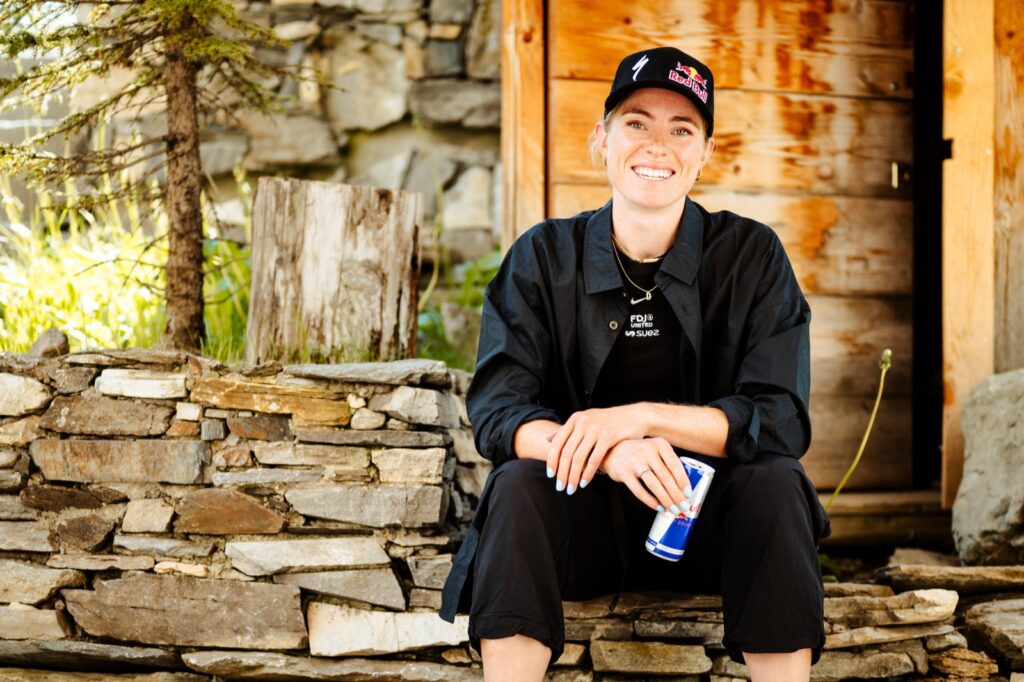
It would be tempting to explain the deal through individual athletes. Kate Courtney is an obvious Red Bull bridge: a multidisciplinary rider and existing Red Bull athlete whose move to FDJ made the launch feel natural. Demi Vollering is the commercial anchor any major partner would notice: a former Tour winner, an elite performer and one of the defining names in women’s road cycling.
Both matter. Neither is enough to explain the deal alone. The announced partnership is team-wide. The helmets are team-wide. The performance relationship is framed around the organisation. That makes the cleanest reading: athlete-enabled, not athlete-dependent.
This distinction matters for sponsors and rights-holders because it separates activation from strategy. Athletes can make a partnership visible and credible. The operating model decides whether the partnership compounds beyond the campaign.
When does a brand need control, and when is access enough?
Red Bull is unusually comfortable with ownership, infrastructure and deep integration. That is why the restraint in this deal is interesting. If Red Bull wanted to announce another full cycling platform under its own name, the market knows what that could look like. It did not do that here, at least not publicly.
A more pragmatic interpretation is that Red Bull has chosen access with expansion value. It can test the market, support performance, activate around the Tour Femmes, learn the team and athlete dynamics, and understand how much control it actually needs. For FDJ UNITED-SUEZ, the same structure brings a powerful partner without immediately rewriting the team’s identity.
That is a useful model for a wider sport business question. Not every strategic gap requires immediate ownership. Sometimes the first move is to enter the right layer, with enough operational substance to learn whether more control would create more value.
For rights-holders and brands, the difficult question is rarely whether a partnership can create visibility. It is which layer of access, identity, performance, audience or commercial control actually needs to be owned.
Discuss the strategic layerRed Bull FDJ: FAQs.
Did Red Bull buy FDJ UNITED-SUEZ?
No public source confirms that Red Bull bought or took an ownership stake in FDJ UNITED-SUEZ. The announced deal makes Red Bull a Major Partner and Official Energy Drink Partner, while FDJ and SUEZ remain name partners until the end of 2028.
What did Red Bull announce with FDJ UNITED-SUEZ?
The public announcement describes Red Bull as Major Partner and Official Energy Drink Partner. Riders wear Red Bull-branded helmets, and the partnership includes access to the Red Bull Athlete Performance Center.
Why is the Red Bull FDJ deal strategically interesting?
The deal gives Red Bull access to an elite women’s WorldTour platform without immediately taking naming control or confirmed ownership. It complements Red Bull’s existing men’s cycling platform, athlete network and performance infrastructure.
Is this deal mainly about Kate Courtney or Demi Vollering?
Both athletes strengthen the commercial and sporting logic, but the announced partnership is team-wide. Courtney is a visible Red Bull bridge, Vollering is a major performance and visibility anchor, and FDJ UNITED-SUEZ is the strategic platform.
Source notes.
The deal facts in this article are based on public cycling media reports and official partner context. The strategic reading is an analysis, not a confirmed Red Bull strategy. Sponsorship value, exact contract duration, ownership rights, data rights and any future takeover option have not been publicly established.
- Cyclingnews on Red Bull’s FDJ UNITED-SUEZ partnership, helmet branding and public deal structure: Red Bull set to partner with FDJ UNITED-SUEZ
- Cycling Weekly on Red Bull becoming Major Partner and Official Energy Drink Partner: FDJ UNITED-SUEZ announce major partnership with Red Bull
- Cyclingnews interview context on Red Bull-BORA-hansgrohe, Red Bull’s majority management stake and performance investment: Ralph Denk on choosing Red Bull
- Red Bull on the Red Bull-BORA-hansgrohe talent pathway: Rookies on the rise
- Red Bull Athlete Performance Center: Red Bull Performance
- FDJ UNITED Integrated Report 2025 for team and athlete ranking context: FDJ UNITED Integrated Report
- Cyclingnews on women’s cycling budget pressure and cost inflation: Women’s cycling is booming, but not everyone can keep up
- SUEZ on the FDJ-SUEZ name-partner extension to 2028: FDJ-SUEZ renew commitment
- France Televisions on Tour de France Femmes 2025 audience performance: Tour de France Femmes audience